


Anyone Own A Grizzly G0602 Lathe?
I’m seriously thinking of ordering this lathe.
http://www.grizzly.com/products/10-x-22-Bench-Top-Metal-Lathe/G0602
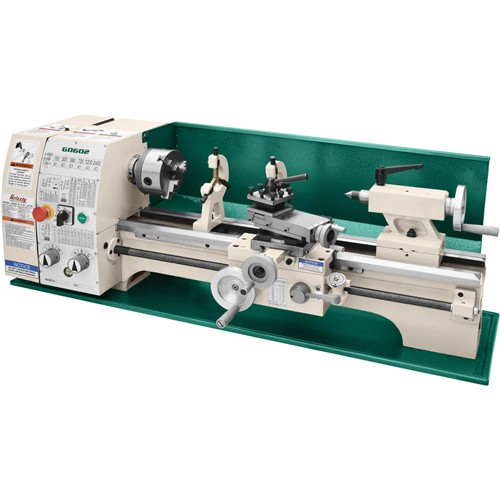
I don’t really have a place to put it or a way to get it into my house quite yet. But they are in stock in a week or two after being out of stock for the last six months.
I have a tool budget I need to burn and I need a lathe to go with my mill for a project I am in the process of designing.
Hoss Machine recommends it highly and it’s a good price considering the capacity. I wish I could go larger but I don’t have the shop for it yet and the other one I want is five times the price… 😯
Anyone with lathe experience is welcome to comment on the positives and negatives of the capacity, drive gears, color, etc.
I’m also looking for similar sized lathe recommendations from different manufacturers… 😉
Oh and AWS welder, i’m getting further along on the end cap. I’ll try to get some photos up soon. I figured out a pretty crafty way of getting the steel into the butt of the grip. I need to start the shaping, it’s just a chunk screwed on the end of the grip right now. It certainly did balance out the pistol though!! Thanks again!!
All Replies
Viewing 4 replies - 1 through 4 (of 4 total)

Viewing 4 replies - 1 through 4 (of 4 total)
- You must be logged in to reply to this topic.
You need to watch this guy do threads on a manual lathe in fact I encourage all to watch it, he is a bit fast and should have explained what he was doing better but I will here! put your threading tool in and square it up to your work peice they make a small guage for this you don’t really need to spend a bunch of time doing this square it off and center it in you shaft! first off on your compound you want it to be set at 29 1/2 degrees to the right of you as you are facing the lathe there are degree marks on your compound where you tool is locked down onfor left hand threads the compound needs to be to the left of you same degree setting 29 1/2,ok next make sure that your dial is on that compound is set to zero, take and move your cairrage over to the peice you are threading turn your cross slide in until you just touch off on your peice set the cross feed dial to zero, now if you watch the video he turns in the compound handle in, you only want to take a couple thousands at a time at the most or less depending on what you are threading the smaller the diameter the less you want to take because of flex, anyway turn in the compound a couple thousands remember your cross feed dial stays on zero engage your threading dial when you get to your stopping point disengage your threading handle then quickly turn out your cross feed dial just like you see him do in the video! ok move your apron back to the start of your thread make sure the cross feed dial you spun out to clear you part is back on zero again sometimes a red or yellow mark on it makes it easier to see that is why when you bump the cross feed out of the way at the end of the thread on your peice you want to go just enough to clear you peice and then go back to the front of your peice and the first thing you want to do is zero out the cross feed! turn in your compoud dial a couple more thousands then engage your threading dial once again when it gets to the end bump in out towards you just a bit then move the carrage back to the front of you work peice zero out cross feed again move the compound another couple thousands and do it all again! if you watch the video and there are more than this one but this guy is old time school and does it the way it should be done! try and remember what I told you here and watch the video you will begin to understand better what he is doing, if I could make a video I would but I have no means to! Now there is a formula for figuring how deep to take you threads say you are doing a 1/4 28 like he is doing you take the thread pitch which is 28 and divide it by a constant which the constant is the same for all american threads it is 750 so you take and divide the 28 threads per inch by 750 and you get 26.785 rounded off close so you are dealing in thousands when you figure this so you compound starting at zero you will move it in aprox 26 thousands plus a little this gets you really close and what I do is take the peice your are threading and try either a nut on it or the peice you are trying to mate to the peice you are threading and just try in see how it fits if it needs a bit more off take very small cuts until your peices thread together well without any play! One other thing when you reach the 26 thousands on this paticular thread the last couple cuts leave the compound at 26 thousands plus then for the last couple cuts move your cross slide in a thousands at a time you only want to take off a couple thousands doing this it will clean up the thread very nice, also alot of guys take a nice sharp lathe file and just clean the top of the thread a bit to take off that sharp edge if you end up with sharp edges on the top of the thread! This sounds like alot to do and for the first time it probably is but once you do it and get used to doing it, it becomes much easier. take some scrap and pratice.
Here is the link he has a couple others to and there are other post on threading watch them over seveal times if you have a laptop watch it while you do your own that might help hope you understand what I explained it is something that would be better hands on but pratice it and you will get better in no time, this is something you have to do and practice and once you get the hang of it you will be good to go 😯 😯
http://www.youtube.com/watch?v=Umf4dDzK7fI
Another example of thread cutting this guy is taking off to much 10 thousands you can get by with that with a heavier shaft but to cut nice threads 2 to 3 thousands at the most in my book, watch how the shaft he is threading flexes!