


Final bits ordered.
Finally ordered the mill today, along with it’s bits & pieces, and some stock at last (various bars and tubes in alu, brass, ss and nylon).
No idea how good this mill will turn out to be, but it was on offer and seems reasonably substantial:
http://www.chestermachinetools.com/store/champion16_variable_speed_mill.htm
All Replies
Viewing 14 replies - 1 through 14 (of 14 total)
How easy is it to fit a DRO kit? The dials on my (chinese) lathe are sloppy as hell, though I understand they can be tightened up. I remember working with sloppy dials when I did my course many years ago, and the slop had to be factored in to the overall measurements. It was a royal PITA.

Langa… If you “dont go for all that”… then your not taking advantage of a Milling Machines accuracy….
Dials or DRO you’d use an edge finder with both. Even with CNC you need to use an edge finder to locate the edges of a workpiece.
I’d suggest you check a local library for a book on machining.
Your old enough to have still had metal shop in secondary school? What happened.. you pick home economics instead?

My DRO cost about the same as my mill…..lol I still cut to the line in many things. But for repeatability and accuracy the DRO is awesome.
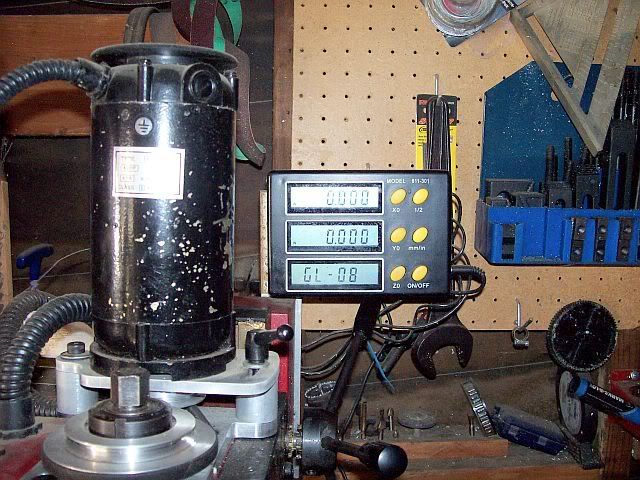

Well, not really. If your dials on your X and Y table are accurate you can use those instead of a DRO.
Got it. Digital Read-Out, requiring a bunch of electronics, drives and a read-out panel. That is some serious shizzle, just looked it up on google and it’s around the £350 mark ($700), presumably a kit one fits oneself.
So unless you go for all that stuff an edge-finder is superfluous?
Langa,
Take this part for example –

Bottom left is 0,0 and everything is measured from that point so you’d use the edge finder to locate the bottom and left corners and then zero your dials (taking into account the edge finders radius) and you then use the dials graduations to measure the distance as you rotate them to accurately position the work under the tool.
DRO’s make that SO much easier, because it doesn’t matter if you lose count – Plus on the Import Mills in the US use very strange graduations that aren’t that nice to use.
Well, you can do it by hand and its ok for one off stuff. If you want to make several of the same part and have them all be interchangeable then you would be well served to get a DRO and learn to use an edgefinder.
Stone me, what would you have to be making to need a rigmarole like like, a map of Brazil? 😯 😆
Who was it that was making that entire rifle from scratch recently…I’m guessing a 3D piece of work like that would need it? Or maybe that would be x, y and z.
Way over my head I’m afraid, far too bloody complicated. I’m sure I could learn it on a course, like most things, but right now I’m still wondering how I’m going to suss out how to change the cogs on my lathe to set up a particular thread to be cut. In the fullness of time no doubt.
Thanks Voltar. 🙂

So, that’s how an edge-finder works but why would you want to find the edge (dumb question alert)?
Edit: Guessing here…to check a piece of work is square on the table?
Lang, you pick up the edges of your workpiece for x, y coordinate machining. Depending on your machine and dials you work from a 0,0 position and then machine/drill, bore as required from that reference.
ie, 2″ square with four holes in the corners at:
0.500″,0.500″ 1.000″, 0.500″ 1.000″, 1.000″ 0.500″, 1.000″
very important for accurate machining as error soes not accumulate as it will with added measurements.
Cheers Adam, there was other good stuff there too.
So, that’s how an edge-finder works but why would you want to find the edge (dumb question alert)?
Edit: Guessing here…to check a piece of work is square on the table?
Now go shopping for collets, vice, cutters, dial indicators, edge finder
and parallels….etc.
I’ve got the collets, cutters and vice on the way already, along with clamps. I already have a dial-gauge.
I’ve heard of an edge-finder, but don’t have a clue how or what it’s used for (well, finding an edge I guess 😆 ). Ditto a parallel.
That should do you just fine. Looks nice.
Now go shopping for collets, vice, cutters, dial indicators, edge finder
and parallels….etc.
Viewing 14 replies - 1 through 14 (of 14 total)
- You must be logged in to reply to this topic.
Dials or DRO you’d use an edge finder with both. Even with CNC you need to use an edge finder to locate the edges of a workpiece.
I’d suggest you check a local library for a book on machining.
Your old enough to have still had metal shop in secondary school? What happened.. you pick home economics instead?
No, I did metal-work, but we spent most of our time bringing in plastic soldiers and tanks and burning them in the furnace. I think I made one or two copper bowls, but when they wouldn’t let me make a shotgun I lost interest, especially when another kid was allowed to make a crossbow but I was refused that as well.
I have bought a few books on machining, slowly working my way through them. Very very basic stuff though. I don’t think CNC had been invented when they were written. 😆