Q:

EdGun ? Weaver or Picatinny rail?

Which is it?
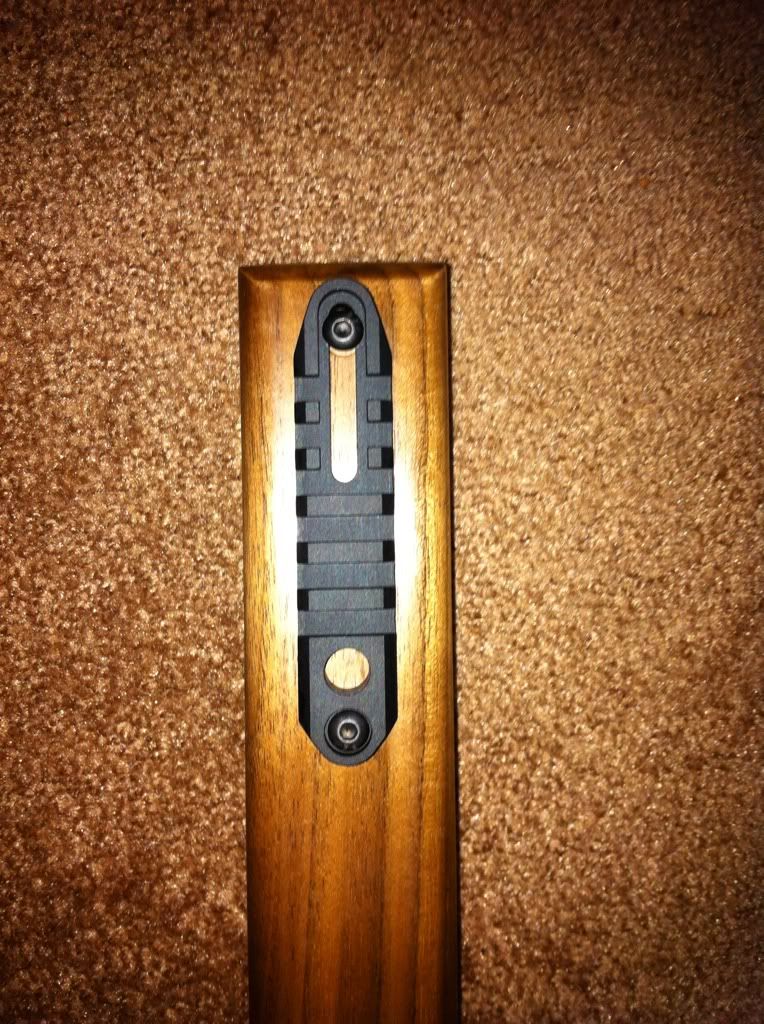
Also what is the weaver/picatinny dovetail with stud mount I’ve seen mounted on the bottom of the forearm of some rifles to attach a bi pod to?
Thanks,
Frank

EdGun

All Replies

Viewing 7 replies - 1 through 7 (of 7 total)

I did a post for AF gun users wanting a genuine picatinny rail… http://www.talonairgun.com/forum/viewtopic.php?t=25350

quote jdr724:

I understand it to be a picatinny rail so you can use either weaver or picatinny rings. In general picatinny mounts won’t fit on weaver rails but you shouldn’t have to worry about that.

+1 picatinny accessories don’t generally work on weaver mounts but the reverse does work.

Thanks for the input guys. Particularly the schooling on what and why the difference Rossal!

Rossal,

Excellent explanation!! I learned something today, thank you.

FVA,

This is what I have on my R3:

Manufacturer website:
http://www.accu-shot.com/catalog/product_info.php?cPath=23&products_id=69

Gabe G.

New Matador Rail Dimension are…..
Lug Spacing is 0.209
Lug width is 0.183

Picatinny Rails, Weaver Rails, What’s The Difference?

The “Picatinny Rail” is a term that has evolved in the firearm industry from a military standard, specifically MIL-STD-1913 (AR) which was adopted on February 3, 1995. The title of the publication is “Dimensioning Of Accessory Mounting Rail For Small Arms Weapons” and this document specified exactly what the dimensions and tolerances were for any mounting systems that were to be submitted for acceptance by the military. The term “Picatinny” comes from the place of origin for this system, the Picatinny Arsenal located in New Jersey. MIL-STD-1913 specifies the dimensions required for consideration, including length, width, height, and angles and the tolerances allowed for each measurement. The key distinction of the MIL-STD-1913 lies in the specification for the profile and the recoil groove.

What are the differences between the “Picatinny” and the “Weaver” systems? The profile of the two systems is virtually identical. Depending on the quality of the machining done by the manufacturer, the two systems should be indistinguishable from the profile. The key difference lies in the placement of the recoil grooves and with width of the grooves. MIL-STD-1913 (Picatinny) grooves are .206” wide and have a center-to-center width of .394”. The placement of these grooves has to be consistent in order for it to be a true “Picatinny” MIL-STD system. Weaver systems have a .180” width of recoil groove and are not necessarily consistent in a center-to-center measurement from one groove to the next. In many instances, a Weaver system has a specific application that it is machined for, so interchangeability is not necessarily an issue. A MIL-STD-1913 system must adhere to the specifications listed above in order for it to be considered MIL-STD, since the military desires uniformity in the recoil grooves to allow for different systems to be mounted on the weapon with no concern for compatibility.

Now, what does this mean to you? Boiled down, it means that accessories designed for a Weaver system will, in most cases, fit on a “Picatinny” system. The reverse, however, is probably not the case. Due to the larger recoil groove, “Picatinny” accessories will not fit a Weaver system. There are, of course, exceptions to every rule, but for a good rule-of-thumb, “Picatinny” won’t fit Weaver, but Weaver will fit “Picatinny”.

I understand it to be a picatinny rail so you can use either weaver or picatinny rings. In general picatinny mounts won’t fit on weaver rails but you shouldn’t have to worry about that.

Most accessories that fit picatinny will also fit weaver and vice a versa. If you mount a small picatinny rail you can get an adapter to mount your bipod. Some bipods are already setup to be picatinny compatible. I just mounted a standard sling stud right to the wooden forearm and use my standard Harris bipod that clips to a sling stud.

Viewing 7 replies - 1 through 7 (of 7 total)

  • You must be logged in to reply to this topic.