Q:

Mil Dot Ranging

I found this on another site wanted to share it here ————

ive always wanted to use the mil dots in my scope for rangefinding of my target, but never really looked into it as i thought it would be very complicated, but i have sat down and looked into it, and found it to be very simple!

the concept requires you to know the rough size of your target (e.g. a rabit 6 inchs), measure up the target in mil dots through your scope (say 3.5 mil dots high for example) , perform a little maths or use a chart, and you have the distance of your target (range will be roughly 47.6 yards), simples!! well im not to fast with the calculations in my head, so after a few hours of work, i have put together a customisable chart in excel.
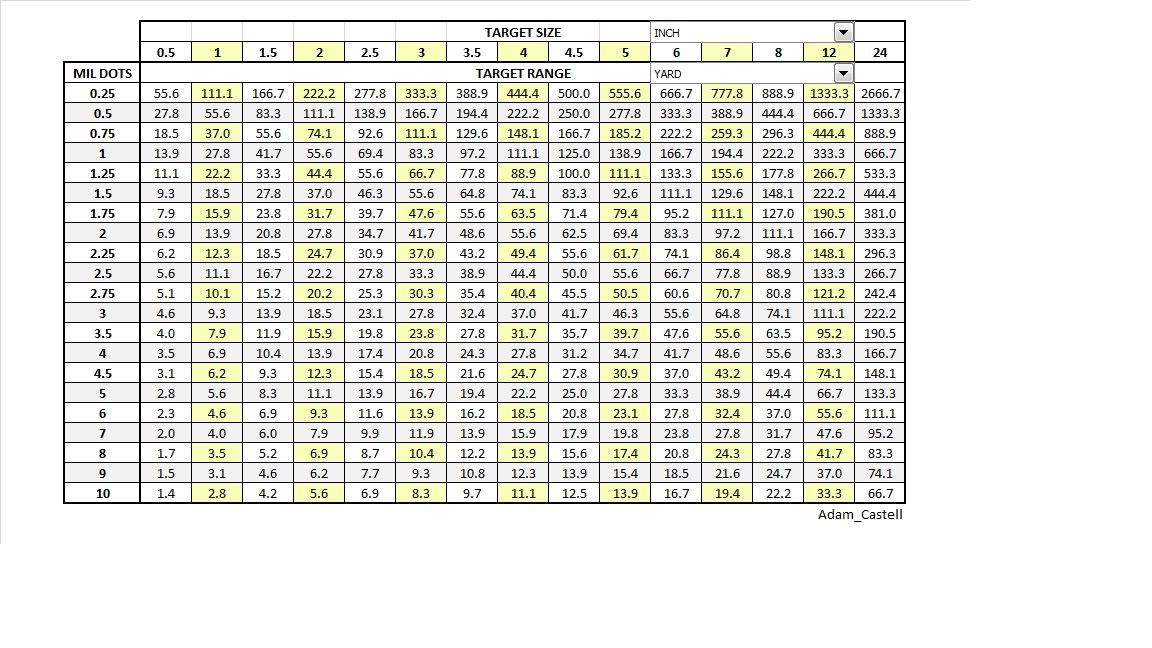
also attached is my excel file, you can choose your target units of measurement in the drop down box, and retype actual values in the target section, and also select the distance units from the drop down box.

hope it is of use to others!


Attachments:

General Chat

All Replies

Viewing 11 replies - 1 through 11 (of 11 total)

Well the chart I linked you can change all the measurements

Sent from my Samsung Galaxy S4

quote 07condor22:

quote acourvil:

For a first focal plane scope, it will be the same at all magnification levels, but the size of the reticle lines will change, too (thicker at high magnification, thinner at low magnification), and depending on the reticle it might be too thick or to hard to see at a given resolution.

Just a little something to add: you are correct in your description, but an FFP reticle never covers more or less of the target @ any magnification. Even through at 3x the mil-dot reticle looks like a fine duplex, it cover the same amount of target as at 12x! At 12x the reticle appears thick (as a telephone pole some say) and it still only covers the same amount of target as it did on 3x

A SFP scope reticle is stuck stationary and only the sight picture moves with magnification change and not on scale with the reticle. In an FFP scope the reticle scales with the sight picture. So both remain to scale or move together with magnification change. Most only see the reticle changing in size, ignoring the fact the sight picture is changing size at the same time in scale.

I’m trying to bust the ever lasting myth that an FFP reticle covers more of the target at high mag and less at low mag, thus covering up the target at hi mag! This is just pure turtle fur at it finest :winkn:

BTW I use a no math required reticle range finding system, however it does require a scope with mil turrets and mil dot reticle. MOA turrets wont work, requires math converting mils to MOAs. Also requires drop chart in meters and target size in centimeters. I know who in the U.S. knows anything about meters, I do ๐Ÿ˜ˆ

fyi this is the math for mils – Size of item in inches x 27.8 (25.4) รท Mils read = Distance to target in yards (meters)

quote acourvil:

Well, a decent scope should not change POI when the magnification changes IF you adjust the parallax properly.

What do you class as ‘ a decent scope’ ?
I’ve used scopes up to 500 bucks or so. Changing the mag’ (parallax adjusted) still fudges with the poi….

quote acourvil:

For a first focal plane scope, it will be the same at all magnification levels, but the size of the reticle lines will change, too (thicker at high magnification, thinner at low magnification), and depending on the reticle it might be too thick or to hard to see at a given resolution.

Just a little something to add: you are correct in your description, but an FFP reticle never covers more or less of the target @ any magnification. Even through at 3x the mil-dot reticle looks like a fine duplex, it cover the same amount of target as at 12x! At 12x the reticle appears thick (as a telephone pole some say) and it still only covers the same amount of target as it did on 3x

A SFP scope reticle is stuck stationary and only the sight picture moves with magnification change and not on scale with the reticle. In an FFP scope the reticle scales with the sight picture. So both remain to scale or move together with magnification change. Most only see the reticle changing in size, ignoring the fact the sight picture is changing size at the same time in scale.

I’m trying to bust the ever lasting myth that an FFP reticle covers more of the target at high mag and less at low mag, thus covering up the target at hi mag! This is just pure turtle fur at it finest :winkn:

Well, a decent scope should not change POI when the magnification changes IF you adjust the parallax properly.

quote pablouk:

Unfortunately unless you have a high end scope, changing mag’ will also change the poi. Best to leave the mag as is and learn your hold over/under, even if the up close stuff is a bit blurry…

Thanks.

quote BobLeeSwagger:

Hi and, first of all, thanks for the chart in excel.

Developing the discussion, what if the the scope has variable zoom?

Say a 3-9×40 scope. When one goes from 3x to 9x magnification, the MilDot reticle size doesn’t change whereas the picture changes 3-fold, meaning all size corrections vary as well, correct?

Yes, I have read about SFL and FFL recticles but, in practice I would like to know which one is better (OR IF it depends on the situation).

Thanks!

Unfortunately unless you have a high end scope, changing mag’ will also change the poi. Best to leave the mag as is and learn your hold over/under, even if the up close stuff is a bit blurry…

Acourvil, thanks for the complete explanation. That answered to all my questions!

For a first focal plane scope, it will be the same at all magnification levels, but the size of the reticle lines will change, too (thicker at high magnification, thinner at low magnification), and depending on the reticle it might be too thick or to hard to see at a given resolution.

For a second focal plane scope, the chart will be right at one magnification level (e.g., 10x, or maybe the highest magnification). You can do simple math to get it at other resolutions, but if you are already doing math to estimate the range, another step increases the chance that you mess something up.

What I have mostly heard is that if the kind of shooting you will do is at rest or you have time to range, second focal plane has the advantage of a uniform reticle. If you are doing more dynamic shooting where you need to range with the reticle, on the fly, then first focal plane has some advantages. In general, first focal plane adds $$$ to the price of the scope compared to second focal plane.

Personally, the time required to do the math and the inaccuracy from estimating range from the reticle outweighs the time/inconvenience of using a laser rangefinder.

Hi and, first of all, thanks for the chart in excel.

Developing the discussion, what if the the scope has variable zoom?

Say a 3-9×40 scope. When one goes from 3x to 9x magnification, the MilDot reticle size doesn’t change whereas the picture changes 3-fold, meaning all size corrections vary as well, correct?

Yes, I have read about SFL and FFL recticles but, in practice I would like to know which one is better (OR IF it depends on the situation).

Thanks!

Viewing 11 replies - 1 through 11 (of 11 total)

  • You must be logged in to reply to this topic.