Q:

Vulcan Surfaces aka Level Level Level Leaves Offset Error

Finally have my scope vertically stacked with Vulcan’s barrel, but discovered that you can’t trust anything on the gun or scope to be actually level.

I had naively used the tactic of the Level Level Level. That makes you think you got things aligned when the sprit levels are all “level” on the scope turret, the gun and the reticle is vertical. That turned out not to be enough, because not only do things need to be level, but the scope needs to be parallel and centered side to side with the barrel. Otherwise, the scope will be offset to the side of POI except at one zero point (the collimation point).

This diagram shows how the offset becomes a problem that worsens beyond the zero point. I calculated that just a 2 degree error with our high mounted bullpup scopes translates to nearly 1/2 inch POI error at 4 times the zero distance. It’s not huge, but why leave a system error when it can be reduced? This isn’t cant error. You can be Level Level Level but still be offset.

I got a Vertical Reticle Instrument from Brownell’s
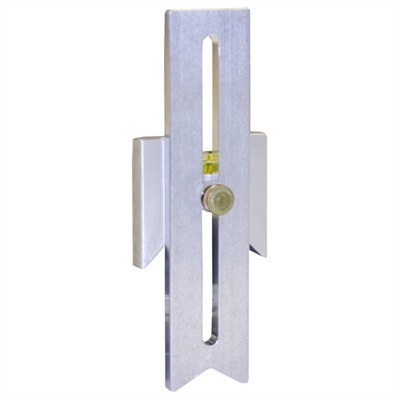
It works by centering itself over BOTH barrel and scope. The level on the instrument reads level when the scope is actually centered left/right over the barrel. The machining was far better than I could make and I verified their level with a plumb line.

You tilt the gun left/right until the VRI shows the scope and barrel are stacked vertically. That is the position you keep as “level” for the gun. From there, you rotate the scope to get its reticle vertical (or even more accurately its vertical tracking vertical, but I’m not that good). Lock the scope down with its reticle vertical and the VRI still indicating barrel and scope are correct.

Once done, I found not a single surface on the scope or Vulcan reads as level when things are actually aligned correctly. Everywhere there was 1-2 degrees of tit on what one could have naively assumed as correct if one relied purely on levels. The turret cap, the barrel cover, the breach block, the mounting rail — none were level or agreed with each other.

Without the VRI, getting things Level Level Level would actually induce an offset mount. Now if my rings were machined exactly right to remove all errors of the mounting rail and other parts of the Vulcan, Level Level Level might have also avoided an offset error, but my rings aren’t an exact match.

The VRI revealed the error and made it very simple and quick to get things actually aligned correctly.

Tips:

1. Remove your scope’s lens caps. The scope ends must be ROUND.

2. Put the Vertical Reticle Instrument on the scope and barrel with its set screw loose. Then tighen the set screw. If you do it right, there is only one position the VRI “locks” itself into place.

3. As you tighten down the scope, the distance between the barrel and scope decreases and can shift the VRI. That can fool you into thinking the gun shifted. You may need to loosen the VRI’s set screw to let it settle back into position

4. If you only check the front of the scope vs the barrel, there is the chance that only the front of the scope is centered over the barrel, but not the back. This is worsened if you have one of your mounts flipped around instead of both the same direction. You can check if the scope is also L/R parallel with the barrel by getting the VRI to read centered in front, then putting it on the back of the scope and verifying that things are OK on that end as well relative to the vulcan’s barrel cover.

5. Once the VRI reads level, and the scope is secured with its reticle level, you can adjust your anti-cant device to also read level. Do this last.

Overall, I give a big thumbs up to the VRI for showing me I can’t trust any surface of the Vulcan or scope to be level when the scope, barrel, and reticle are all in their actual correct relationship.

Airgun Technology

All Replies

Viewing 15 replies - 1 through 15 (of 19 total)

1 2

Yes, that’s true ! ……… those are the distances that is already setup for me at the place where I target/test shoot.

Also. when the gun is new I check the frame for proper alignments with the jugs I’ve made.
Found only a couple of guns to be very close to exact and I’ve return guns that I found to be way off.
I suspected that my Cricket compact new at that time had been damaged from shipping with a twisted frame.
I return it and got one that was acceptable.

~ Greg

no, one must check it at very close range too, as close as you can focus down and one far point and that’s it,
there is no point checking at 2 far distances only.

what I do now is I optically center the scope then shim it without touching scope turrets, had some weird issues with scope and POI, it was not the gun alignement but the scope inner tube skew,
since I am not touching the turrets from optical axis, not seen these anymore

seeing is not all believing that could be caused by other issues as well …….

If one gets the same POI from left to right at 50, 75 and 100 yards there good to go, if not you’d what to check into it more.

just saying …………

~ GKU

just another idea, if you mount a nightvision addon on your scope and with infra red illumination, you can nicely see what is your pellet is doing, or how it travels.

typically I see many youtube videos, when pellet starts off on side and heads towards the crosshairs. maybe I will find some video and add it here.

…no need to go too anal with the scope and gun alignement.

Kris hi

On reflection I am such a poor shot i wont do the box test.
More to gain by practice which is certainly more fun.
In my case ” a little knowledge is dangerous” J

Thanks for tip

Safe shooting

you may find that you optically center and you are happy, than you touch the front objective or the side wheel and refocus, or change the magnification and whoops
everything is off again
:angrymob:

if you start doing things like the box test and so, you will end up spending big time on new expensive scopes
:whistle:

not good for the Missuz

Acourvil

Thanks for that info. I have learned something.
Forward to box testing for me then. Do the guys use a clamp or vice system for holding ? Do you think a normal bench rest position is adequate?
As a novice it is somewhat of a steep learning curve.

Difficult for some though because not all scopes have mil/mil turrets.

Safe shooting

quote mikewh:

Most illuminating article.
Has this process ever been applied to seriously long range firearms such as the world record holding longest confirmed kill held by an Accuracy International in .338 . Fitted doubtless with top quality mounts and serious scope. Be interesting to know ? This kill was over 2500 yards in a variable wind. Point being how much does this level level level matter? For that matter any testing for level level level been done by any long range shooters? Would have thought more variables lie in ammunition, human interface including eyesight, weather and what one had for lunch yesterday amongst others.

The guns the long range guys are shooting are machined at much higher tolerances, so it is easier to confirm alignment by reference to surfaces on the action. Air guns, even very nice ones, are usually not machined at that tolerance level.

It’s very common for long range guys to do a box test to check the scope function and alignment. Basically, you shoot a box by dialing elevation and windage (e.g., 20MOA right, 20 MOA up, 20MOA left, 20 MOA down) a couple times. If you are canted, the elevation impacts will show variation from the center line. If everything works, it doesn’t matter how you did it. If it doesn’t work, then you have to figure out whether the scope is bad or there’s something off with the mount.

I mounted my Vulcan with one piece mount. I sent scope to swafa to go over it and optically center it. After mounting it with usual level I found out its 2 clicks high at 50 and 5 or 7 clicks left or right I can’t remember. I was very impressed how closely related the axis were. My mount has a 20 moa taper to it which in my opinion is something that should have been done at the factory. I’m out 200 some bucks but it is grade A stuff and does what it should do. I want to add both my crickets were not nearly as close as the Vulcan. I use the Burris signature rings to fix this problem on cricket but it’s very time consuming but worth it. For some reason the Burris rings with inserts didn’t hold zero on Vulcan so I looked for another solution and am quite happy with it

Most illuminating article.
Has this process ever been applied to seriously long range firearms such as the world record holding longest confirmed kill held by an Accuracy International in .338 . Fitted doubtless with top quality mounts and serious scope. Be interesting to know ? This kill was over 2500 yards in a variable wind. Point being how much does this level level level matter? For that matter any testing for level level level been done by any long range shooters? Would have thought more variables lie in ammunition, human interface including eyesight, weather and what one had for lunch yesterday amongst others.
I wonder what sniper101 would comment?
In real terms an air rifle is very short range.

However extremely well put together article.

no, I was saying that most of the folks don’t bother to optically center their scopes, they dial the turrets until it is no going back hehehe.
Other do try to optically center, but then, they just use their turrets anyway. hehehe
look you have to decide what is good for you, if it is worth your time /money.

your tool must be good if you like it.

is any benefit using it? I mean is the gun shooting better now?

I totally agree that centering the optics of a scope optimize its optical performance. I have no issue with that. but it is ironic that your centering those optics and making the scope optically coaxial, you have removed the main concern as to the validity of the VRI measuring against the scope body.

By optically centering as you describe, you have optimized the scope to be refined with the VRI. Hence, the reason to not use the VRI becomes irrelevant.
One can still adjust the mounts and shims to avoid the windage and elevation turret adjustments. The VRI offers you a chance to also eliminate offset at the same time.

As to whether the motions of the erector tube cause a shift in optical axis and renders the VRI meaningless….

I did the near and far pin experiment to see how much the pins shift relative to each other as windage is adjusted.
If they were rock steady relative to each other as windage was adjusted, then the optical axis is not shifting relative to the scope body.
if they move, then the axis does shift.

On my particular scope, I found the pins do move a little relative to each other BUT the motion of the reticle is by FAR larger.
I had trouble detecting the relative shift of the pins until windage was over 4 MILRAD off center — way more adjust than I ever would accept.

So, I conclude that while large windage adjustments (over 4 Mil Dots) do shift the optical center of the scope,
a few clicks left or right don’t deviate the axis enough to invalidate the VRI reference against the scope tube.

The VRI does offer an additional adjustment accuracy to getting a scope actually centered above the barrel.
This is something that mere eye balling or using just levels on parts of the gun can’t achieve.

quote kris:

guykuo there is another tube inside the scope so there is no point perfectly aligning the outer tube to the gun or to the barrel.

I have never seen a perfectly optically centered scope (on its own) and a perfectly aligned barrel,

I think it is more important to be aware of the parallax error, when you move your eye sideways or up and down and the reticles move around the target, if you are not careful the POI will not be the POA. only at a single distance will the crosshairs stay on the sample place, you set this distance with the sidefocus wheel or the front objective. if you have a clear picture it does not mean that the parallax is set also right remember too. with low magnification it is easy to get sharp picture, but it will still show parallax error if your eye is not in the center.

I have to agree though that if you have some daft mounts, the scope can be off a lot, to see if this is a case you can turn them 180deg and see the effect.
if you are not by mms off on the rail, the scope should be ok. I still like to play with my scope to optically center, and shim it instead of using the windage and elevation turrets.

if you dial your turrets, you move the inside tube all over the place.

on some guns, not the Vulcan you can rotate the barrel around the axis, and almost in every single case the POIs will describe a circle, so there is no perfectly straight shooting barrel either. sorry.

that’s normal.

+ 1

I would optically center the scope properly, clamp the gun and shoot it so you see to POI, then put the scope on the mounts and adjust the mounts if you can (if you have adjustable) without touching the turrets. you may need to shim it on the bottom or side to get the crosshairs at the poi or so (considering holdovers etc).
that’s the best for your scope performance. I have not found a better way doing it.

Viewing 15 replies - 1 through 15 (of 19 total)

1 2
  • You must be logged in to reply to this topic.