


zero
what yardage is your zero? The highest point of trajectory ? I dont know what that would be, Im assumeing 40 yards.
All Replies


With zero droop and zero on the elevation knob they would be parallel.
Still it is an excellent site.
Edit. I may be wrong (quite often am) but isn’t the point at which the line
of site crosses (or not crosses) the bore centerline controlled by the
elevation knob or shimming the scope in the mounts or machining the
scope mounts (Mac1) ?
Oh dude, you’re less confused than you think you are 😉 ………
It’s the OPBZ calculator that uses the term “secondary zero” to describe what most folks call their “primary zero”.
B.B. uses the same language in the blog about sight in yardage:
http://www.pyramydair.com/blog/2005/06/at-what-range-should-you-zero-your.html
Note that the article doesn’t doesn’t do nearly as much justice to the topic as does applying the OPBZ calculator to numerically tell you your zero distances.
Vertical alignment is certainly affected by the elevation knob, by shimming the mount, or by installing compensated “drooper mounts” (or the Burris Signature ring inserts). The latter two become essential if you run out of vertical adjustment on your scope OR if you desire to stay more within the middle of your scope’s adjustment range.
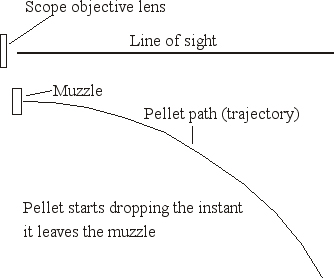
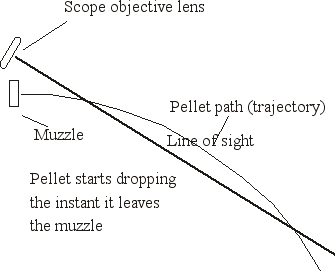
“SECONDARY ZERO” refers to the range where the projectile first crosses the LOS on it’s way up to the apogee. Think of the apogee as the range to the highest point in the trajectory where the projectile “kisses” the top edge of the vital zone radius.
(per the AirHog blog):
“Optimum point blank zero” is the “zero” that will give you the greatest span of ranges at which a directly aimed shot will produce a point of impact close enough to “get the job done.” Getting the job done, of course, might involving knocking down a field target, taking small game, or something else.
So, for example, suppose you have an air rifle that launches pellets at 820 fps and the sight height is 1.5 inches (from the center of the sight to the center of the bore), and you decide that it will be acceptable if your pellets land within a .25-inch radius of your aiming point . . . then if you zero your sights at 33.2 yards, all shots from 11.2 yards to 36.9 yards will land within a quarter-inch of point blank if you are shooting correctly. That’s a range of 25 yards where all you have to do is point and shoot.
Suppose you decide that it would be satisfactory if your shots landed within a half-inch radius of your point of aim. If you zero at 38.6 yards, you get a range of 34.4 yards (from 7.5 to 43.9 yards) in which you can simply point and shoot.
When someone naively posts the question “what range should I sight in at?”, I feel that it’s a perfect opportunity to share what I have found to be a very usefeul ballistics concept. All of my airguns are now set up this way, it’s scary how much fun it is.
I know but the graphic shows the line of site crossing the bore centerline.
With zero droop and zero on the elevation knob they would be parallel.
Still it is an excellent site.
Edit. I may be wrong (quite often am) but isn’t the point at which the line
of site crosses (or not crosses) the bore centerline controlled by the
elevation knob or shimming the scope in the mounts or machining the
scope mounts (Mac1) ?
But it does not allow you to enter a scope droop or gain value.
The graphic sure shows some droop. Wonder what the math assumes ?
There’s no scope droop – there’s only line of sight straight through the optics – which is a straight line, bore centerline – which is also a straight line, and pellet trajectory – which is a curved line due to gravity.
Thank ZHH. That is great.
But it does not allow you to enter a scope droop or gain value.
The graphic sure shows some droop. Wonder what the math assumes ?
Here’s a graphic simulation with the explanation of exactly what you are talking about —>

Take a look at CROWPOPPER’S figuers.
If he 0’ed at 20yards he would have another 0 at 60yards.
I am using a 21.4gr pellet. A 24″ .22 BSA barrel with a hybrid hammer and an experthpa tank & 1400psi regulator.
This gives me these two 0 figures. Like others have said the figures can change loads depending on what you are using.
Don’t rely too much on software as it is not perfect. Just go out and shoot loads of pellets until you are happy.
If like me you have a regulated setup try the following.
Zero at your prefered distance.
Now take 5-10 shots from a prone position at 5yard intervalls from 10yards out to say 75yards (depending on you power)
Colate all info and sketch it out on a graph or use MS Excel. You will nsee your pellet trajectory on paper.

This is so true. My 40 yard zero is not the same as 20yrds. I shoot to see my zero and it can tell you more when you shoot it. Chairgun is cool to have but field testing with a hunting rig like Condors are the way to go. A 40 yard zero just maybe like 37yards for a true zero but for hunting and it’s all good when it comes to killing shit. 😀

my condor shooting u=eunjins is
10 yds 5 low
20 yds 2 inchs low
25 dead on out to 50
60 2 inches low
100 5.5 low

use chairgun and play with the numbers
Sure, every gun and ammo is going to be different
Your right but a twenty yard zero means the second poi will be closer to 100 yards than 40. A.F. condor shooting 30.7 Gr. Beeman Kodiaks close to 1000, 56 M.M. objective, I’m guessing around 2.5 inches separation between LOS and bore
He ‘s correct, the pellet will cross your line of sight twice, as it comes out the barrel it will be moveing in an upward arc , and at some point begins to drop in an arc crossing over your line of again .
20 and 40 yards are just numbers, depending on the varibles it may be 30 ,60.. 40 ,80 …
The thing is,you must find the apex of the arc for your gun with that paticular ammo at that paticular velocity , if any of these are varied Your point of impact will vary .
I read an article from an “expert” who said a 20 yard zero would give me another poi at 40 yards. Well IDK what I did wrong but it didn’t work for me. Seems to me the separation between bore and line of sight has to come into play here. I’m going to sight my friend in at 50 yards.
- You must be logged in to reply to this topic.
20 and 40 yards are just numbers, depending on the varibles it may be 30 ,60.. 40 ,80 …
The thing is,you must find the apex of the arc for your gun with that paticular ammo at that paticular velocity , if any of these are varied Your point of impact will vary .
Don’t take this as argumentative but the pellet does not leave to bore in an upward arc. The scopes (L.O.S.) line of sight looks downward.