



Moisture Problem
Hi guys , New to the forum and have a question i hope you can help with……I recently purchased a Freedom 8 compressor and i’m having trouble with moisture on the output side……I installed a moisture trap on the input side from the start but i still get moisture on the output…….Can i put a moisture trap on the output? I don’t think they will hold up to the pressure….Any help is appreciated….
Thanks
Mike
All Replies


I bleed my air off at the moisture separator.
Dmann11, you should machine a bleed valve with some dead space for water collection and a right angle connection for its input. That would make is more convenient to mount the filter upright (no severe bend of inlet tubing) and provide the needed drainage. That would be a neat add on product.

Just one issue I see…
You still need a bleed valve to dump excess moisture otherwise you will saturate that filter in no time…

Thats a really good solution for every Diablo owner. Reliable way of upgrading the filter and to see when the lifespan of the filter is done.
Marko
So I bought one of these filter https://www.filtertechs.com/shop/product_info.php?cPath=96_20_130&products_id=394.
Dumped the dissicant out of the Diablo tube. Soaked a blue shop cloth with laquer thinner wiped the od pulled a dried towel through the Diablo tube. Rubbed silicone grease on the filter oring shoved it into the Diablo tube past charcoal end past the the thread ends. Real tight fit screwed on the ends.



So, before the PMV. Can this be retrofitted before the PMV on a Bauer Jr? I’m worried that rigid fittings extending out from the filter housing to the indicator & PMV would act as a lever arm and risk shearing a connection. Would you use flexible hoses between the filter housing and the rest of the output chain?
The PMV is built into the filter tower on the Bauer Junior II so you would just have to add this on the outlet. Leverage on the fitting is always a concern. I would find a spot on the compressor to mount it and just use a jumper hose from the outlet of the filter to the inlet of the moisture eye.
I have a couple alumnium based rock grinders I very familiar with moisture corrosion of painted and anodized aluminum surfaces. I ended up blasting them and had them powder coated to hold the corrosion in check.
2 1/2 hrs on the dissicant in my Diablo shows 0 signs of moisture. He’s making unsubstantiated claims against a air system he has no experience with just shit he reads and sees on the Internet. Not that it matters but I have purchased one of Jamie’s filter and will be plumbing it in along side the Diablo. I will also be checking out a filter cartridge for the Diablo.
I think that the Filter Cartridges will work in the Diablo. I have not seen or measured the inside. But from the Dimension You gave me I should be able to make a Sleeve that will fit over the end of the filter With an oring. The filter will then be able to Utilize the cartridges that mine and the Coltri Use…
The Filter cartridge Doesn’t Really hold any Pressure so to speak… (maybe a little while the air is channeling through)
Now your still Missing a way to Remove any residual moisture from the Filter body? You may be able to Put a Moisture bleed valve Like I have on my Max air (culture)…
Ray shows a picture of aluminum corrosion and waterx. That’s it he claims the tank is anodized. The pic isn’t a active link to and article. Whole change in facts being disputed here.
I’ve never claimed it was invulnerable, the guy shows me a pic of aluminium with moisture corrosion from improper filling.
I have a couple alumnium based rock grinders I very familiar with moisture corrosion of painted and anodized aluminum surfaces. I ended up blasting them and had them powder coated to hold the corrosion in check.
2 1/2 hrs on the dissicant in my Diablo shows 0 signs of moisture. He’s making unsubstantiated claims against a air system he has no experience with just shit he reads and sees on the Internet. Not that it matters but I have purchased one of Jamie’s filter and will be plumbing it in along side the Diablo. I will also be checking out a filter cartridge for the Diablo.
I follow the line of logic leading to Ray’s showing the tank image. There was a suggestion that anodization renders the Diablo invulnerable to all corrosion. Ray showed the image of an anodized aluminum tank to show that anodization doesn’t produce complete invulnerability to corrosion. Ergo, anodization of a Diablo does not render it invulnerable to corrosion.
On the other hand, looking through designs for molecular sieve vessel in large industrial processes, I have yet to find any mention of a need to prevent direct contact between the vessel wall and the molecular sieve.
Sorry if this information has offended you somehow. But facts are facts.
Fact are facts. you failed to show failure of the Diablo dry air system. You introduce a picture of what looks like a scuba tank with moisture corrosion of some sort caused from BAD FILLING procedure. I thought we were talking about dissicant packing and moisture corrosion stemming from wet beads touching the pressure vessel sides. What offends me is what you offer as a fix. I on the other hand think the fix lays in a filter cartridge that cost less then $30
Thanks, Ray. That indicator would seem a good, objective indicator of when the filter cartridge is nearing end of life. At the very least, it would let one know they are about to deliver excessive moisture content.
So, before the PMV. Can this be retrofitted before the PMV on a Bauer Jr? I’m worried that rigid fittings extending out from the filter housing to the indicator & PMV would act as a lever arm and risk shearing a connection. Would you use flexible hoses between the filter housing and the rest of the output chain?
http://www.augustindustries.com/visual-indicator-ind-mois.asp
would be of utility in our systems? The pricing seems doable even for an air gunner. Was actually looking for an electronic humidity meter that can handle 4500+ PSI, but didn’t find something anywhere near this thing’s $200 (after fittings and discs) level.
That is probably the best of the moisture indicators on the market. I sell a lot of them to my compressor customers with a 10/20/30 disc for breathing air although the 40 strips seem to be more popular with the paintball crowd. It works best before a pressure maintaining valve.
Show me one Diablo tube where the anodic oxide finish that on the interior has failed from the moist dissicant.
You guys keep repeating that the moist dissicant is corrosive to aluminum. The Diablo tube isn’t just thick 6061t6 aluminum tube.
Stop quoting shit isn’t up to industry standards and fucking show me proof where the product has failed.
I am VERY familiar with anodizing as it has been used in the HP air industry for YEARS! But anodizing is not the be all end all solution. It is, after all, a form of protective corrosion. But moisture is still the enemy of the surface. We learned that the hard way in the scuba industry early in the 70s. This is a picture of an anodized tank inside that has had moisture introduced over and over again by bad filling practices and/or a failed filter system. And if you think that anodized aluminum doesn’t fail, just google aluminum tank explosion and see the hundreds of examples.
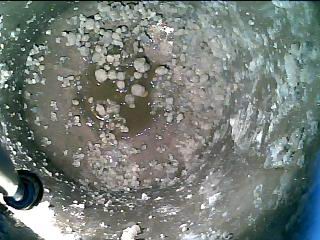
As for failure of the Diablo itself, I have not heard of it. However, I had never heard of Diablo until a couple of weeks ago. But I will bet dollars to donuts that as more people use them, we will start seeing corrosion spots starting right where the first felt pad sits on the wall since it is the first thing to get wet.
Sorry if this information has offended you somehow. But facts are facts.
- You must be logged in to reply to this topic.
As the air cools further between the moisture separator and at the filter housing base, additional condensation occurs. A bleeder right at the dryer base lets you remove that and further reduce the amount that the molecular sieve needs to absorb. It’s a much smaller amount of condensate than at the separator, but it’s another chance to maximize mechanical separation before making the drier deal with it.