Q:

Mrodair Airmax Compressor Review: Prep, Poor Build Quality, Fixes, Ultimately Unsafe for Use

For those working on their MrodAir Airmax Extreme compressor, this thread is both a resource and report of my own experience. Work on my compressor evolved over time. Initially, the focus was preparing the compressor for a longer life, easier maintenance scheduling, and safer operation. As issues were discovered, this devolved into troubleshooting, fixes, and currently finding my compressor unsafe to use until an oil-in-air problem fix is found at Mrodair.

You can follow my journey beginning in October last year http://www.talonairgun.com/forum/viewtopic.php?f=52&t=33430
This thread is that Guinea Pig thread’s more useful successor.

The first few posts in this thread cover major topics. The major topic posts continually undergo editing to keep information up to date. They do not attempt to preserve chronology. Posts after the major topics are chronologic, just as in any normal thread.

NB. Changes in the major topic posts are not flagged as new by the BBS system.

===========================
Disclaimer: Material presented here may be incomplete or inaccurate.
Work you undertake on a compressor is expressly at your own risk.
===========================

Introduction

I pre-ordered my Airmax compressor from MrodAir after watching their product introduction video and reading the website. My impression was that the compressor would be a mid-priced, mid-performance machine suitable for my limited, single shooter needs. The promise that a US outfit would be going over the units and making sure they worked was reassuring. With its advertised “silicon bronze rings”, “3 cylinders”, and real pistons, this seemed a happy medium between an o-ring based compressor and the “overkill” of a dive compressor.

We were reassured by MrodAir that each unit would be tested and that they had arranged many upgrades. These compressors would be long lasting, “real deal” compressors. As an airgun newbie, I was unfamiliar with MrodAir. There were some negative online reviews, but I also know that online reviews often trend towards the negative – even unfairly. I took a chance, ordered a compressor, and promised to report my experience on this forum.

My desire was a compressor that would let me fill or top up a tank reliably. I was only a single shooter, but the convenience of ready air was enticing. Also, the ability to use high air consuming items, like regulator testers, made a compressor/tank combo a nice step up from hand pumping.

My experience has not been consistent with a ready to go, fully developed product. Others have fared both better and worse than I. There are issues potential buyers should know before purchase.

False Advertising
There were factual inaccuracies in the product advertising at MrodAir. These incorrect details affected my decision to place an order. Had they been accurate, I might not have placed an order.

As described on the product page when I ordered the machine…

quote :

Finally a real 110 compressor…….True 3 cylinder, with real pistons and rings made from silicon bronze for long service life…

No, this is a TWO stage compressor. Only two cylinders do actual compression. Although the 2nd stage piston rides atop a carrier piston, that carrier piston does zero compression work. It is drilled through and lacks air inlet or outlet. It is simply not a compression cylinder. The compressor can still achieve 4500 psi by making the two stages work harder, but the 3 cylinder count is a factual error. I am only counting cylinders that perform compression. Otherwise, one could lash a six-pack of beer to the compressor and dub it a 9 cylinder compressor. Two cylinders means each must do more work than in a three stage machine. There is also less chance for interstage cooling of the compressed air.

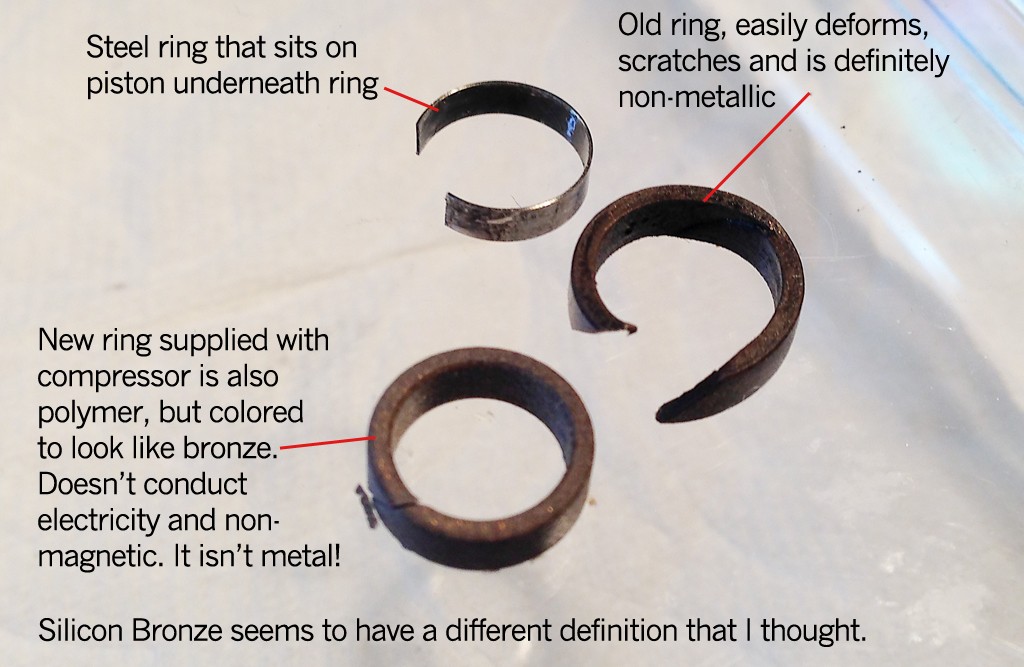
Silicon bronze piston rings were prominently mentioned as a feature of the compressor. This gave the impression that rebuild intervals would be consistent with that of metal piston rings. I was surprised to find my 2nd stage piston rings were not metallic. The rings resisting the greatest heat and pressure, are polymer
Several other owners confirmed that the high pressure cylinder rings. I informed MrodAir and the initial reaction was that I was wrong. Their website continued to advertise these compressors as having silicon bronze rings for several days more.

quote :

….the new Airmax Extreme and it IS a true 3 cylinder HPA compressor, with real pistons and high pressure rings made from silicon bronze, suspended in phenolic resin for long service life…..The low pressure cylinder, has traditional cast iron rings.

Piston ring description was adjusted as of 4/22/2016. The high pressure rings are now described as silicon bronze suspended in phenolic resin and the low pressure rings as traditional cast iron. The number of cylinders advertised remains three.

Because the 2nd stage rings are now known to be a less durable material than silicon bronze, having replacements is even more important. The high pressure rings look like angle cut wear rings. They are soft and easily indent with a fingernail. Heat, flame and smell testing of one from my compressor makes me think these are actually silicon bronze filled PTFE wear rings. I would like to find a second source. I have yet to find a source for bronze filled phenolic resin rings, but silicon bronze filled PTFE wear rings do exist.

Durability and duty cycle should be scaled back in your mind. Filling a 88 cf tank in one session stresses the compressor to its limit. A reasonable expectation would be to top off a tank once in a while or fill a gun directly. Long term torture testing suggests 20 minute max run times. http://www.gatewaytoairguns.org/GTA/index.php?topic=107945.0

Technically, the compressors are 120 volt units, but they need a 30 amp service outlet to run properly. A 20 amp circuit is insufficient. My own unit draws about 24-27 amps during operation. It is simply too large a current draw to safely run on a 20 amp circuit. Perhaps one could get away with it for filling a gun directly, but topping or filling a tank is asking a lot of a 20 amp circuit.

Electrical Hazard
My unit arrived with two major electrical components (relay and contactor) hanging loose. Each was held in place only by the wires connected to them. A consumer who receives the machine reasonably expects safe and secure wiring. If your unit arrives in the state mine did, disaster will happen in short order.

The compressor is not grounded. Grounding pin of its AC power socket is connected to ….. nothing. This machine has a semi-open, metal frame, uses water for cooling, and is not grounded.

An under capacity 15 amp IEC receptacle connects the AC power cord to the compressor. The IEC connector is only 15 amp rated, well below the actual current draw of the compressor. The IEC power connector can overheat or starve the machine of adequate power.

Electrical wring skills can correct these shortcomings. It is doable, but for a vetted design and build, the average buyer should not need to do electrical rework.

Air Quality with Heavy Oil Contamination, (Critical Go/No Go Safety Item)
My unit, and that of some other owners, continually passes oil from the crankcase into the low pressure cylinder. Oil that gets into the air path oxidizes (maybe even diesels) at the high pressure cylinder, fouling that cylinder’s rings and valves. The remaining oil goes on to the water separator and MUST be filtered out before it reaches a gun or tank. A little oil is not uncommon for a compressor, but it must be removed with a filter before it gets into your tank or gun. My unit splatters oil all about in the low pressure cylinder. Bleeding the separator filled my garage with suspended oil vapor. Not all units have this problem. Mine does and so do some other owner’s. This is distinct from being shipped with oil in the crankcase. It’s actively putting more oil into the cylinder with each stroke.

This oiling issue should be tested before one puts the compressor into use. An affected compressor will still fill a tank. Merely testing whether the compressor will fill a tank is insufficient. You should disconnect the air output of the 1st stage and specifically check for continued oil output before you try a pressurized run. Without my large, Alpha filter, this would have been an oil in the tank disaster. With my Alpha, it is still a problem. A filter can only handle do so much. Filters are meant to deal with the the last traces of oil, not heavy contamination. Oil in your high pressure air system is an explosion hazard and may negatively affect seals in your guns.

Summary
There are indeed MrodAir upgrades like the automatic cutoff gauge and radiator. Those are useful, but one needs to go over these units carefully before use. Expect to do electrical and mechanical work to keep them running. Mine, as delivered, was neither turnkey nor ready to use. Ultimately, mine had such severe oil contamination issues that it was unusable and no fix was forthcoming from Mrodair. On the up side, the compressor is easy to tear down and work upon. If good parts were available, and fixes developed, one could conceivably keep a unit running until one could afford a more robust solution. Just anticipate needing your mechanical and electrical skills.

The compressor does fill fast – perhaps too fast for its own good, Takes about 80-90 minutes to fill a Great White from empty to 4500 that’s with frequent bleeding. It’s just a tad over 1 CFM. You can actually see the pressure gauge of a Great White move as the compressor works. However, there are reliability, longevity, duty cycle, and oil contamination issues that need working through. I never got mine sorted after months of patient work.

My story follows. You will learn about initial inspection, electrical, air leaks, oil in air contamination, and blowouts. There is even a down trodden me “throwing in the towel” and ready to scrap the machine after first discovering heavy oil contamination and suffering another o-ring blowout while filling a tank.

I think one might get this compressor to marginally work directly filling a gun or a small cylinder, but expect very slow to no customer support if you encounter real issues. This is a machine built to the barest margins possible to still run. It has no pressure safety releases and should not be run more than 15 – 20 minutes at a time. You need electrical and mechanical skills to keep things in good order. This is of course, if you get a good unit in the first place. Test thoroughly when it arrives. You are the factory’s last quality control step.

Guy

Main Topic Posts Index

30 amp 120 volt RV service outlet Installation.
http://www.talonairgun.com/forum/viewtopic.php?f=52&t=34635#p357139

Delivered Components
http://www.talonairgun.com/forum/viewtopic.php?f=52&t=34635#p357140

Initial Inspection
http://www.talonairgun.com/forum/viewtopic.php?f=52&t=34635#p357141

inspection of cylinders for oil seepage during shipment
http://www.talonairgun.com/forum/viewtopic.php?f=52&t=34635#p357142

Opening Crank Case for Complete Oil Change (No, not for routine changes!)
http://www.talonairgun.com/forum/viewtopic.php?f=52&t=34635#p357143

Electrical Fixes and Upgrades
http://www.talonairgun.com/forum/viewtopic.php?f=52&t=34635#p357145

High Pressure Valve and Water Separator
http://www.talonairgun.com/forum/viewtopic.php?f=52&t=34635#p357146

Automatic Pressure Switch Gauge Glycerin
http://www.talonairgun.com/forum/viewtopic.php?f=52&t=34635#p357147

Water Cooling System
http://www.talonairgun.com/forum/viewtopic.php?f=52&t=34635#p357148

Piston and Piston Ring Measurements
http://www.talonairgun.com/forum/viewtopic.php?f=52&t=34635&start=60#p359151

O-ring Sizes
http://www.talonairgun.com/forum/viewtopic.php?f=52&t=34635&start=40#p358769

Latest changes
5/21/2016
No Mrodair fix for the oil in air contamination issues. Lower pressure cylinder consumes oil severely. Small engine shop evaluation suggested piston and cylinder tolerance are too large to ever effect a seal. Without a way to fix that problem, the compressor is unsafe to use. My unit is now going to another victim/owner for use as a parts donor.

If you are contemplating this compressor… my painfully earned advice is to buy from a different dealer and get a Shoebox or save up for a full scale dive compressor. The Mrodair Airmax Extreme compressor is a poor quality product you will most likely regret.

Compressors, tanks and pumps

All Replies

Viewing 15 replies - 241 through 255 (of 267 total)

1 2 3 16 17 18

Thanks for all your work on this thread. It is really appreciated and what makes this forum a great resource is the willingness to share.

As for your compressor, sorry that it ended up the way it did especially after you put so much into it.

You gave it every chance and went far beyond what you should have to do.

Unbelievable !!

Where has Micheal been? Has he chimed in on any compressor thread lately? I see on the yellow he’s trying to push guns with a buy one get one sale to pay his taxes
:whistle:

While doing more post mortem examination today, I found another surprise. Those “silicon bronze” piston rings aren’t actually metallic. Well most of it isn’t anyways. There is a thin, inner spring steel spring under each high pressure ring. The high pressure rings themselves are some sort of polymer. Real pistons and silicon bronze rings were another reason I thought this compressor would have a longer life span. The sealing/wear element of the high pressure rings are NOT metallic. They are colored to look like bronze, but GEEZ plastic isn’t going to last like the touted metallic rings.
The ring material even dents with a fingernail.

EDIT: just to clarify. I checked with a magnet to determine if the steel ring was somehow embedded as part of the new rings. Bronze is not magnetic, but it definitely should conduct electricity. None of my rings conduct electricity per my ohmmeter and some very sharp needle probes. They are polymer.

Even though you did all this work it still failed.

I wonder what lurks inside the compressors of those who have not checked them?

I’d like to try one more last ditch effort if I get the o-ring suitably replaced. Final trial will be with less oil in in crank case. I’ll see if filing only to bottom of sighting hole improves the oil pass through situation. If it does reduce the oil issue a good deal, then I’ll keep working to see if I can get this working for me. If the oil situation isn’t improved, it really is time to call it quits. Won’t know until I can source the right o-ring.

Meanwhile, may as well show some info from the Great White filling attempt.

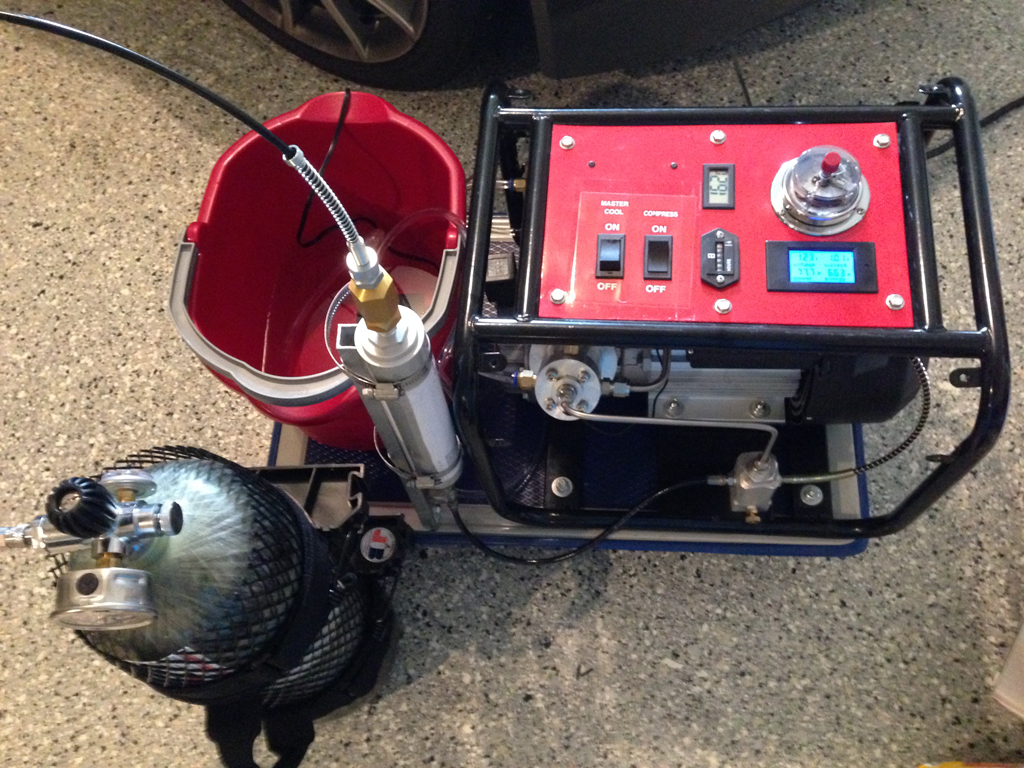
Here is the setup nicely on a rolling cart. My submersible pump is in the bucket and moving plenty of water.
You an see the JB Alpha filter vertically mounted on a stand I added to the cart.

The short fill whip between the JB Alpha filter and water separator was stolen from my Hill pump. Had to do that because the fill whip included with the compressor has a brass colored quick connect that refuses to hook onto most of my male QC’s. Pushing all the way metal to metal still won’t achieve locking. On the other hand, the female QC’s on my Hill pump whip, and all the hoses from Joe Brancato are stainless steel and easily lock onto all my male fittings. The female QC included with Airmax compressor is so out of spec that I can barely latch it onto my Vulcan fill probe. It won’t latch at all onto the Brancato stainless steel male fittings.

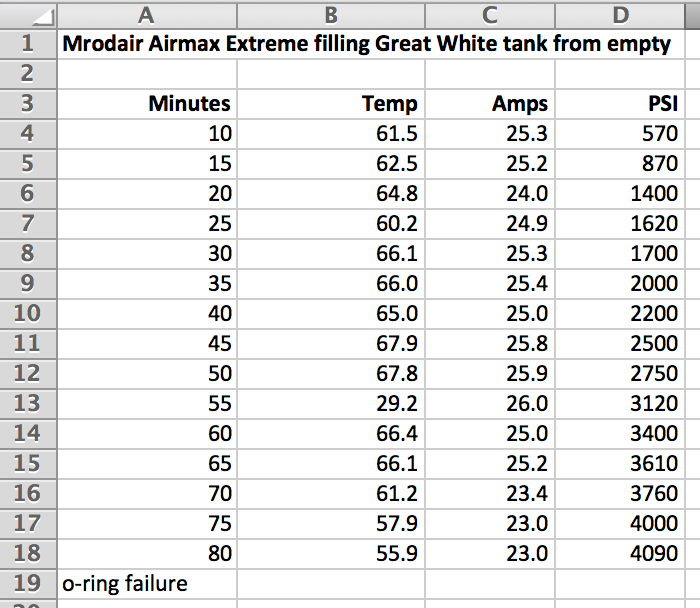
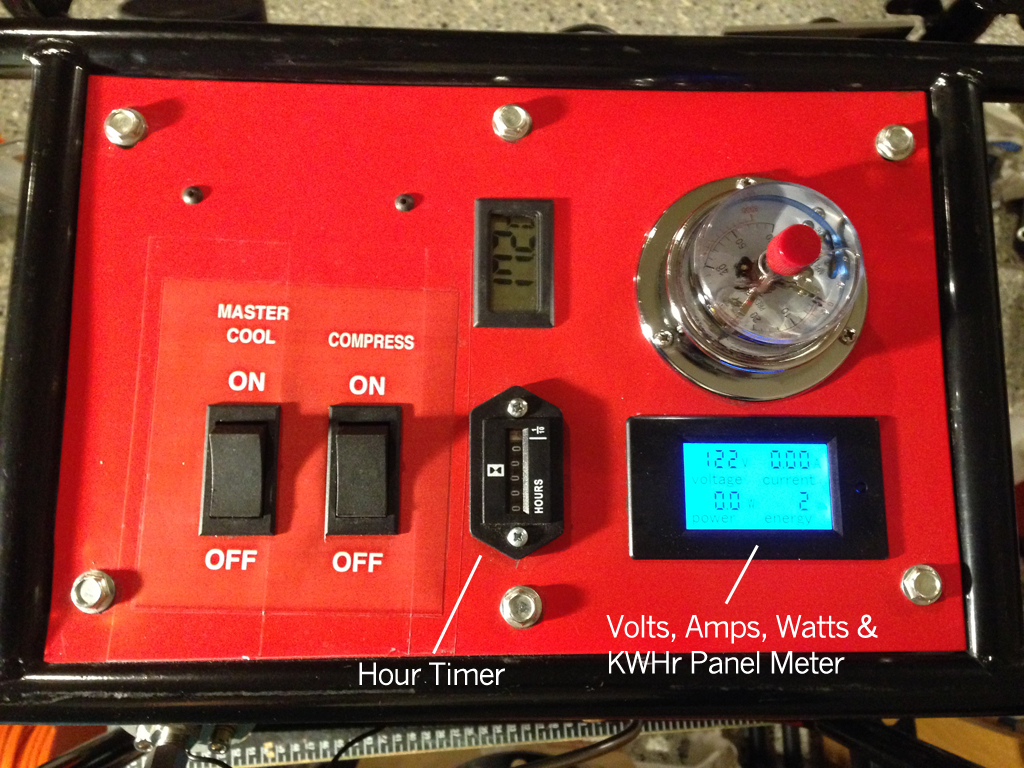
My power meter, switches and cooling system worked great. Here is some data I gathered during filling the Great White starting from empty. I initially bled every 4-5 minutes and increase the frequency as pressure rose. No need to turn off the compressor during bleeding. Just crack the valve a little and let blow out until no more water sprayed out. My sequence was to bleed the compressor’s water separator first. Then I would bleed the Brancato dryer. I knew I was bleeding on frequently enough because the JB bleed was a LOT less visible water vapor than the compressor’s. Bleeding only required small volumes and the compressor quickly re-pressurized the separator and Alpha filter in a few seconds.

The filling speed was about that reported by others. I could see the needle slowly moving on the Great White’s gauge during the fill. It was also slow enough the tank only reached about body temperature to the touch. I did take a couple pause of a few minutes to inspect things. You can see those pauses in my data as a temperature drop.

By about 30 minutes I had a garage full of oil mist and had to ventilate the garage. It looked like smoke was coming out of my garage.

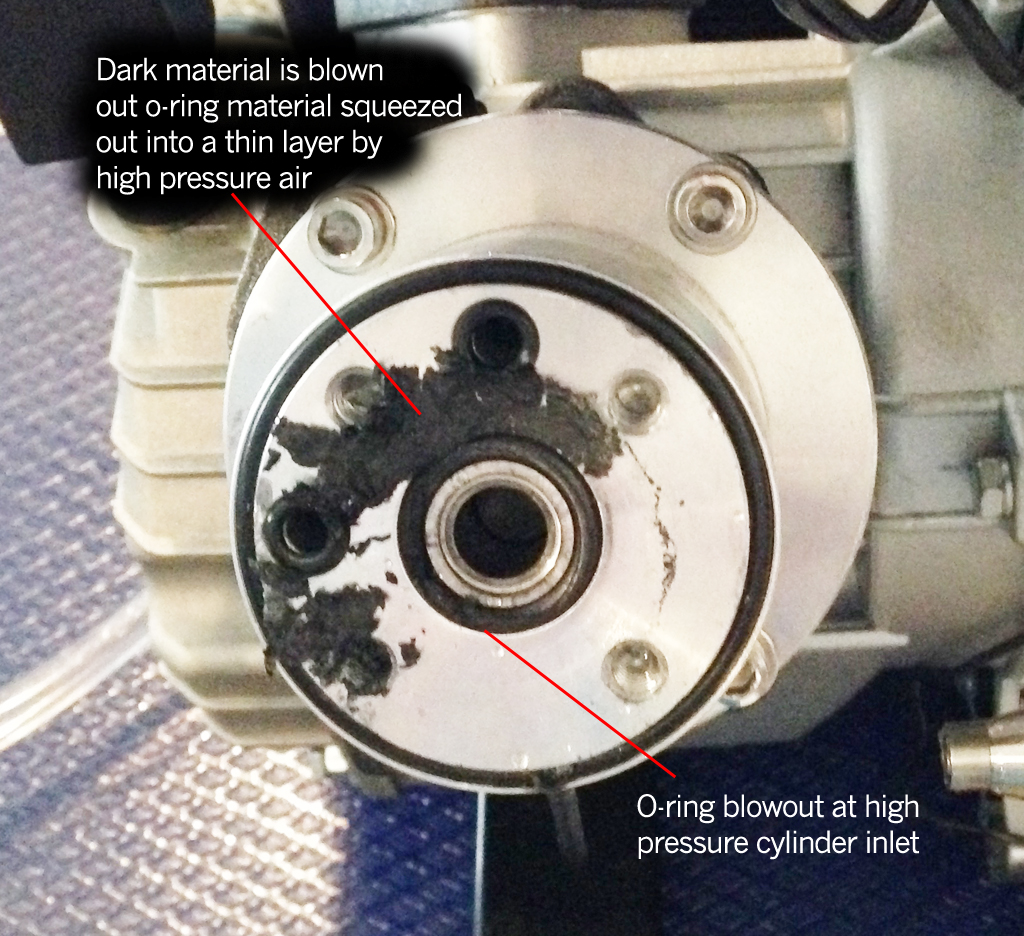
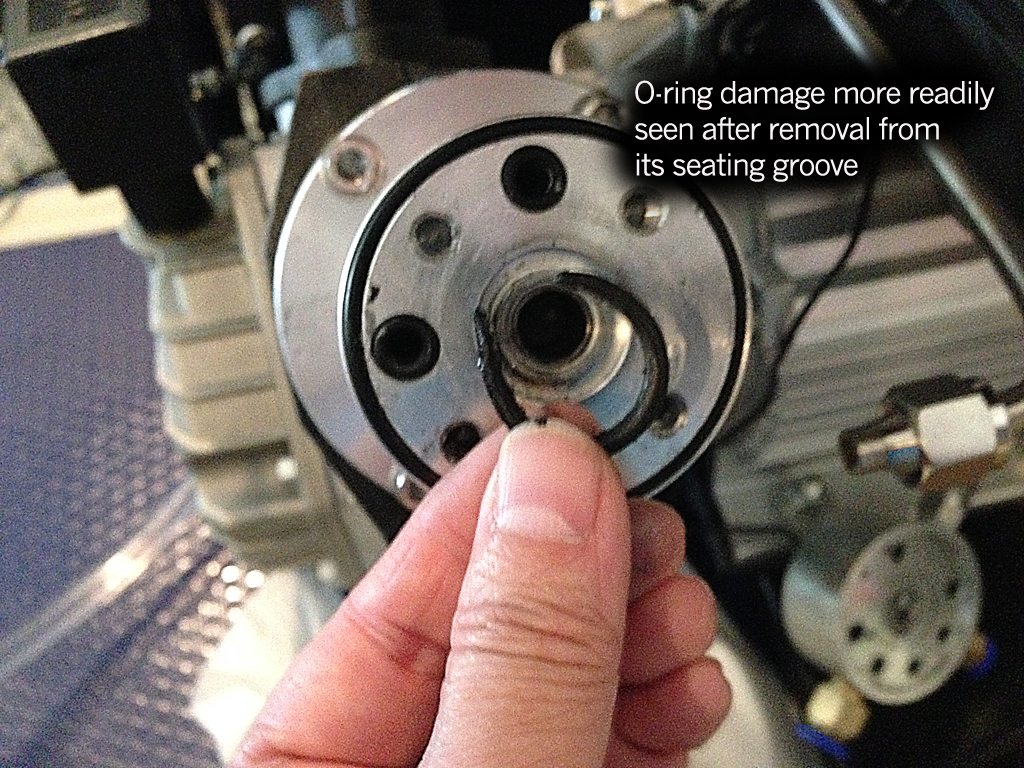
Then 4100 psi was reached and the high pressure head o-ring blew out. That ended things abruptly. Because I saw air suddenly going into the cooling system, I knew where the blowout was. I opened the high pressure cylinder head expecting to see a destroyed o-ring, but I couldn’t understand what all the thin, black stuff was. It looked like plastic from a shopping bag – super thin. Then I noticed that the o-ring was eroded.

The o-ring damage is more visible once removed from its seating channel.

What material, durometer, and dimensions would create the most reliable seal there? I don’t know. It’s subject to both high pressure and temperature. I also think the relatively hard, small water seal o-rings make it harder for the cylinder head to mate metal to metal.

Sorry for your loss. I’m glad I didn’t buy one. Mrod needs to man up and and make good to the buyers of this piece of shit.

I’m not one to expect to return or swap out a unit after I have worked on it. If it turns out, I’m actually calling it quits on this machine, it will simply be a loss.

So, I didn’t write Michael asking for a swap out or return. I merely wrote….

Michael,

I’m really badly discouraged after my first pressurized runs yesterday.
Speed seems normal — about 80 minutes to take a Great White from empty to 4100 psi.
Temperatures stayed well below 70 c. Power usage actually fell somewhat as pressures went up.

Problems that really scare me
1. Large o-ring in high pressure side blew out at 4100. It’s the larger one that surrounds the mounting area of the high pressure inlet valve wafer.
It seals high pressure air from reaching water. So, Got to 4100 psi and it failed. Suddenly lots of air in cooling system instead of water. Of course, I don’t have a suitable replacement in my stock.

2. Lots of oil is getting through to the final output. I didn’t notice until about 30 minutes into the filling session. I bled every 4-5 minutes to keep moisture down. It smelled like oil on my hands. Then I noticed that I couldn’t see across my garage as clearly. The air was filled with aerosolized oil. Looked like I had a fire in the garage it was so thick. The oil issue is probably the most serious. I absolutely don’t want to be breathing this during fills and it’s not something I want on my cars.
Fill of oil was to center of sight port dot. Would underselling solve this or is it simply sucking oil into the cylinders during air intake phase of stroke?

3. Went ahead and inspected the high pressure rings since I had to take the high pressure side apart to find the blowout. Despite 1.1 hours total run time, there was already a LOT of carbon built up on and between all the rings. Does this portend poorly for time between rebuilds?

So depressed and on cusp of giving up after all this work.

Guy

Great review and great job upgrading Guy. have you made arrangements with Michael to return the unit for one shipped without oil?

[EDIT: I was really badly discouraged by oil contamination and a blown out o-ring when I wrote the below. Some more time later, I’m resuming work on the machine and there may yet be hope for getting the oil problem under control. I’m leaving the below largely intact because it conveys how I felt it after so much work. With repositioned piston rings and “under filling” the crank case, the oiling issue might be soluble. There are mixed reports regarding degree of oil contaminating the air. Hopefully, I can get this unit to become one that isn’t such a bad oiling unit.

I’m pronouncing the machine. While I can get it and running (again), I don’t think I’m putting in any more effort on this compressor.

The Great White filling trial uncovered enough issues that I won’t be using the compressor for filling a gun let alone a tank.

Far too much oil gets pushed through the air. While the water separator followed by JB’s air filter clears it out, it’s simply too much for me to tolerate. I had to vent the garage because each venting cycle was filing the air with suspended oil. There is nothing II can do to the machine to stop this from happening.
Speed was great. Took about 80 minutes to reach 4100 in the Great White. That is with bleeding the separator and JB filter every 4-5 minutes at beginning. Every three or so near end.

Had dramatic filling of air into water cooling system when 4100 psi was reached. The o-ring separating the high pressure cylinder from the water jacket had blown out. That ring is right around the high pressure inlet wafer valve. Mechanically, I don’t like that type of seal in such a high temperature and pressure location. It’s going to be prone to repeated failure even if I replace the o-ring.

Lot of carbon buildup on the high pressure rings even with just 80 minutes of run time.

Air in tank post the JB filter is without odor of oil and no water vapor release with venting in inverted position. The JB dryer goes its job!

I started this experiment knowing it might not work out. I’m lucky that I can scrap the machine and move on.
I did the experiment, so you don’t have to.

Yes, I still think it can fill just a gun, but I would not be relying on this for repeated filling of big tanks.
Filtering works for improving its final air quality, but you have to vent during filling to bleed out moisture. That aerosolizes a lot of oil with each bleed. I can get the compressor running, but like I said, I can’t stop it from putting out all that oil mist.
Because of this issue, I’m not going to get it up and running again for just filling my Vulcan.
I want to be able to breath the air in my garage and I doubt the suspended oil vapor is good for my health.

Guy

Edit: Again, I am resuming work on the compressor. I never thought that a pre-checked out unit would have an oiling issue. MrodAir had me open the low pressure cylinder and check the ring clocking, order and orientation. Two of the rings were nearly gap aligned. I have corrected the clocking, but then again I thought rings spin during run time anyways. These are not pinned in place like a 2 stroke engine. I never removed the low pressure cylinder to check the low pressure rings when I did my initial check of the machine. But then, why would one expect to check them?

Talked to Joe Brancato about the Great White tank’s construction. The tank has an inner aluminum liner surrounded by a carbon fiber overwrap. The aluminum liner forms the seal. The carbon fiber withstands the pressure. He also verified that venting the tank “upside down” (valve down) would bleed out fluid in the tank.

So, yes, a Great White could corrode if water were inside the tank.

BTW, if you fill a gun directly from Joe’s air dryer, you also need a bleed valve AFTER the dryer. The pressure maintaining valve won’t let the hose completely bleed down. This isn’t an issue when filling a tank (with their own bleed valve), but it is a problem if you are filling just a gun. He can source an additional bleed valve for post the dryer. I’m getting an extra bleeder to give me full flexibility.

I have decided to go ahead and fill my tank. It will only be fed air that has gone through Brancato’s air dryer and I will recheck by venting the tank after a cooling period.

Next step is devising a water jacket to cool the compressor’s air outlet pipe. That gets super hot with the near adiabatic compression. If I can draw off more heat before the compressed air hits the water separator, more water will condense out. The separator will do a better job. The compressor has a water cooling system anyways. May as well take advantage of it.

The great white is carbon fiber,so no corrosion . Put the tank in water ,less heat build up.

People want to fill tanks so they can travel and hunt

So fill that tanks up!

Did first pressurized runs done today after new water pump arrived. I’ll post more details about minor, easily fixed issues later, but first I have a question for the forum members.

Should I use this just to fill my ONE Vulcan directly or use it to fill my Great White?

The compressor used in combination with my Joe Brancato air dryer very quickly fills my Vulcan. Without any doubt, it can do that job easily and without much strain on the machine. I didn’t do formal timing, but topping my Vulcan from 130 to 250 bar (3600 psi) was so fast that I worried about overshooting the Vulcan’s max pressure. It’s that quick. For filling an air rifle directly, the air volume, run time, and demands for air drying are easily met. I’m shooting, maybe two fills/week tops.

At that low volume and limited max pressure, this compressor is barely stressed and less likely to break down.

BUT…. I also have a brand new Great White tank that I originally purchased to go with this compressor. I could fill the tank and gain the convenience of not going to the garage for a fill. Wow… a whole 50 feet of walking saved. A tank indoors is nice and quiet. On the other hand, this means stressing the compressor with 4500 psi pressure and extended run times. I’ve gone through the machine to address weaknesses. It will probably be okay, but a tank multiplies the moisture removal problem.

I don’t know a good way to check whether or not moisture got into a Great White.
I am admittedly a little scared about a 4500 psi tank corroding and being a death trap.

Right now, my Great White is pristine, having never been filled. It could easily move on to a new home if I decide against using it. Once I fill it, it’s no longer “as new”.

What would you guys do?

1. Just use it to fill directly (good)

2. Fill the Great White (better)

Dear, industrious Guykuo, I applaud your efforts and engineering skills. When you finally produce some high pressure air, you will look back on all your efforts with a sense of accomplishment and pride! You have taken a marginal machine and made it a useful tool. I wish all airgunners had your skill set and tools!

Regards
LarryW 🙄

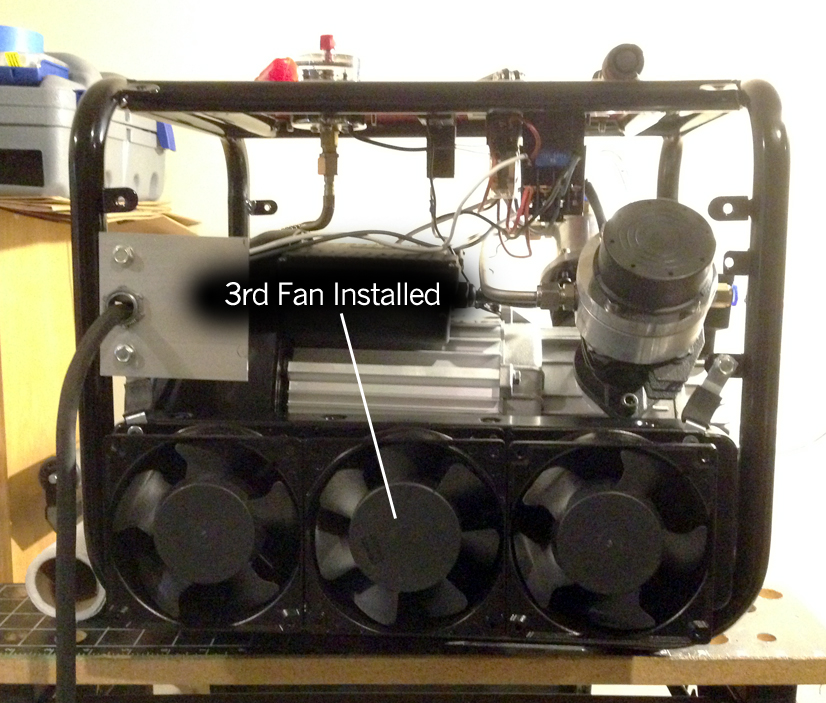
Third cooling fan and power meter arrived today.

Third fan fits nicely. Had to loosen the other two fan’s bolts to slip new one into place. Then bolted up nicely.

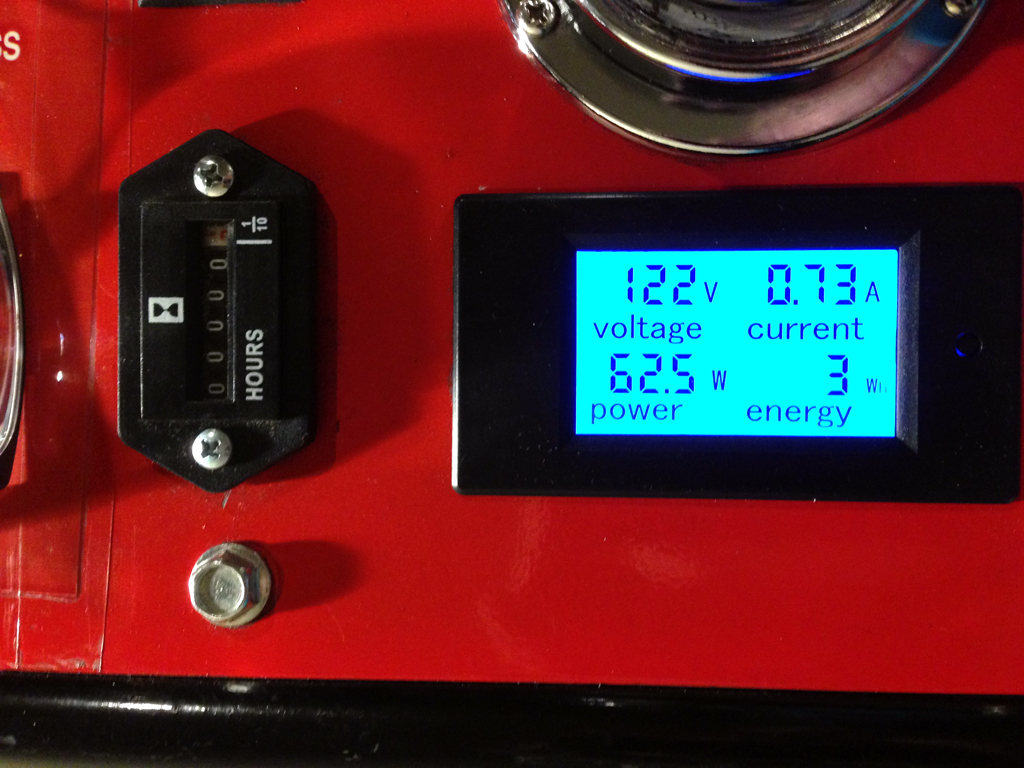
Here is the power draw with three fans (and nothing else) running…

As measured on my newly installed volts, amp, and power meter.

NB: NEVER power up a load if your amp meter’s current transformer is not hooked up. An unloaded CT can generate high voltages – enough to fry its own insulation. Always connect the CT to the meter before power is applied.

Parts used were…
bayite AC 80-260V 100A BYT-VAEM-034 Digital Current Voltage Power Energy Meter Ammeter Voltmeter with Open-close Current Transformer
http://www.amazon.com/80-260V-BYT-VAEM-034-Voltmeter-Open-close-Transformer/dp/B01D8G9GPW?ie=UTF8&psc=1&redirect=true&ref_=oh_aui_detailpage_o02_s00

AC Infinity AXIAL 1238, Muffin Cooling Fan, 115V AC 120mm by 120mm by 38mm High Speed
http://www.amazon.com/AC-Infinity-AXIAL-Muffin-Cooling/dp/B009OWRMZ6?ie=UTF8&psc=1&redirect=true&ref_=oh_aui_detailpage_o02_s00

New submersible water pump arrived and achieved first pressure runs to 250 bar.

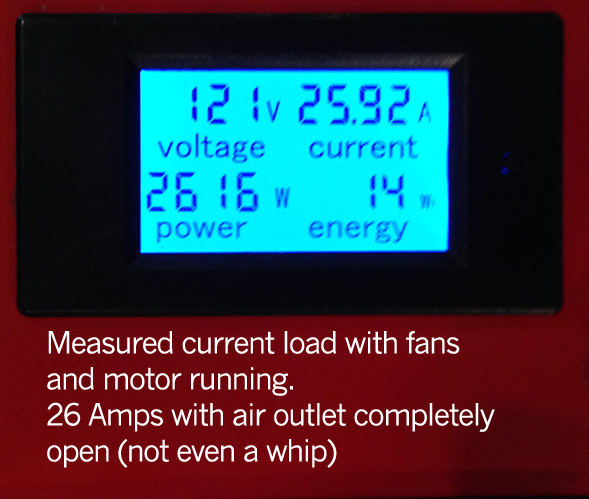
No wonder people are popping their 20 amp circuits. Here is my current draw with the compressor running unloaded. The air outlet didn’t even have a fill whip screwed into it. Granted, this is real amp draw, not apparent amps.

Viewing 15 replies - 241 through 255 (of 267 total)

1 2 3 16 17 18
  • You must be logged in to reply to this topic.