Q:

Edgun R3 .22: Shot String, Air Efficiency, & Trigger

This will be a long post, sorry about that. Ran into the dive shop to fill up the scuba tank yesterday. The shop owner put on a pressure gauge to show me how much the tank was filled, because I was “hinting” at him that I could only fill the gun to 180 bars (~2610 psi) last time with a full tank. The tank was indeed filled to the maximum pressure around 3100 psi in this new fill. Interestingly, again, I only could fill the gun up to ~180 bars based on the gun gauge; but the gauge in the fill adaptor showed 3050 psi (~210 bars). It seems that the pressure of my Edgun was somewhat under measured by 440 psi or 30 bars. 🙄

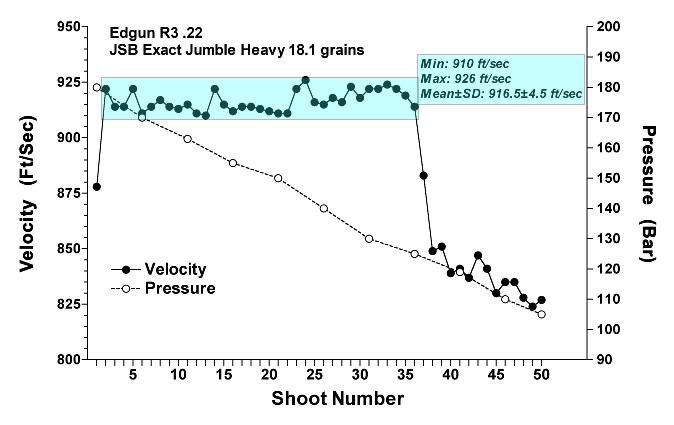
I tested a shot-string using Combro Chronograph, which is a very small and handy chronograph installed at the end of the muzzle area. The starting pressure was 180 bar (based on Edgun gauge) and JSB Heavy (18.1 grains) was used. The first shot was low in speed (878 ft/sec), but the subsequent 35 shots were consistent with average 916.5±4.5 ft/sec (minimum 910 ft/sec and maximum 926 ft/sec). The regulator came off around 130 bars (I think) because of a little rise in speed for several shots and then the speed dropped to around 840 ft/sec for about 13 shots in parallel with pressure drop. The POI (at 30 yards) started to drop slightly (~0.2”) at shot #37 (or the regulator was off at this point?) The POI didn’t further drop until pressure went below 105 bars. I got 35 good shots consuming ~800 psi (from 180 bar to 125 bar) from a 289-cc air tube with average 33.8 foot-pound muzzle energy, which is about 13.1 bar-cc/ft-lb efficiency of air usage. If using Zoco’s data – green-line shot string, 220 bar to 130 bar for 57 shots, ~32.5 fpe (http://talonairgun.com/forum/viewtopic.php?t=19488&postdays=0&postorder=asc&start=520), I got the number 14 bar-cc/ft-lb efficiency.

Based on the data from a shot-string of Royale 400 (without regulator; average 868 fps with 37 fps extreme spread) (http://www.network54.com/Forum/79537/thread/1318702313/FX+Royale+400+.22+-+90+shot+string+with+chart-target), which consumed 0.94 bar/shot (220 to 135 bars for 90 shots) with ~30.3 fpe from a 400-cc bottle, the air efficiency is 12.4 bar-cc/ft-lb. Using another shot-string (http://airgunadvice.net/viewtopic.php?t=12183), from 220 bars to 179 bars with 36 shots (average 954 fps with 28 fps spread) at ~36.6 fpe, I got the same number (12.4 bar-cc/ft-lb) for air efficiency. Using the data from the FX Royale 400 review video of Ted in Youtube, average 33.53 fpe and 20 fps extreme spread with high power, I got 11.1 bar-cc/ft-lb efficiency. If the medium power is used (884 fps with 31.4 fpe and 13 fps extreme spread), the efficiency will be higher at 9.6 bar-cc/ft-lb. It seems Royale is a little bit better than Matador R3 (standard length) in air efficiency without much sacrificing speed variation in the un-regulator gun.

I think Edgun can be optimized by adjusting the combination of regulator and power to reach max efficiency, but it will need a lot of trial. Or this is already at the optimal condition when Ed designed and set up the gun. What do you think?
p.s
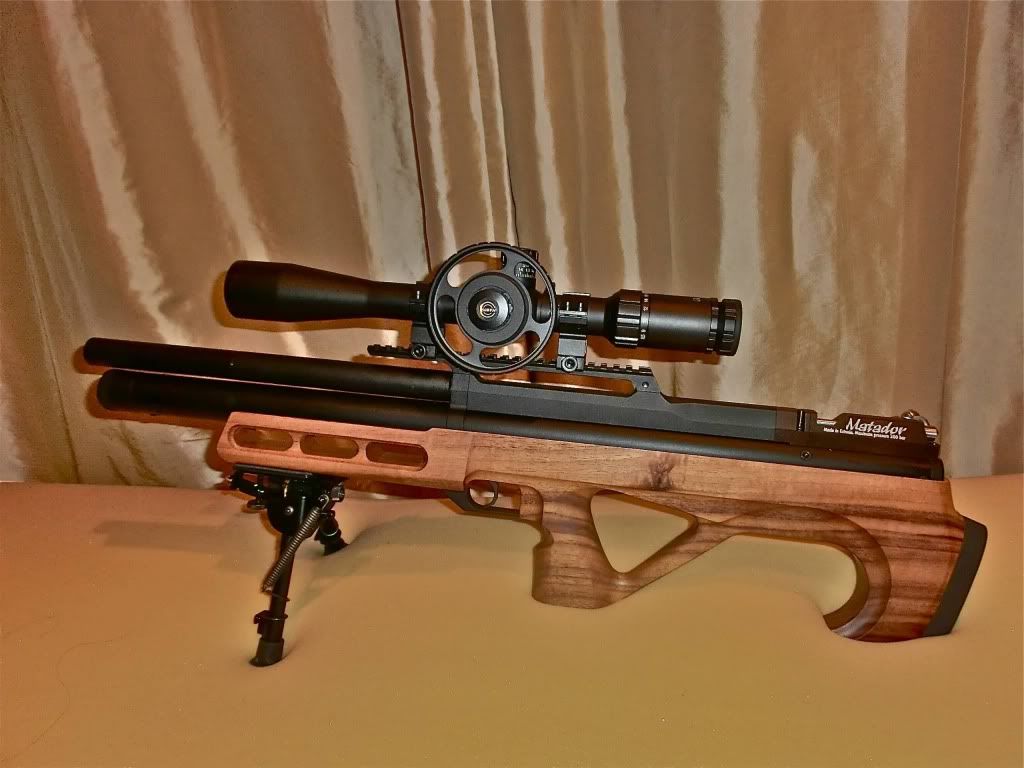
I also installed a Harris bipod BRM-S model 6”-9” in late afternoon, and ran a few shots under high-gust wind (>20 miles/hr) before dark. It seems to improve the unstable sitting of the gun and increase the shooting accuracy. 😛 Will test more tomorrow if weather is good.

EdGun

All Replies

Viewing 15 replies - 61 through 75 (of 229 total)

1 2 3 4 5 6 14 15 16

Hello airgun fanatics,

Im ed (from holland). I want to let you all know how much i enjoyed reading this topic on how to uptimise my hst and regulator. I think this is one of the most contributing tpoics on the edgun so far. I use a 22. standard and i’m planning to do this tune this week. Ive read this topic twice now and i would like to ru it by you all to see if i understood correctly.
-The most important thing about this tune is the hst plateau, the down tune on the regulator is just a result form wanting to shoot at 900 feet with a bit more hst, right?
-First i start with a .25 turn on my reg.
-then see if i can reach the plateau on my hst an d then take futher adjustmenst from there.
-basicly the plateau must be reached at the prefered speed.

Is This the right way to go about it?

Now, i dont use the 18 grainers, i use the 16 grain ones. Yesterday i made a shotstring (actually i made 2). What i notiched was there was no rise in speed at the end. I recently lowerd my hst to get about 905 with 16 grain jsb’s. I also notiched that between shots there is a big differece, ( sometimes almost as big as the maximum difference on the total shotstring). My theory is that both of these things are a result of way to low hst.
I would very much like you re opinion on these thoughts. And i’m open to suggestions.

One more thing, this shotstring is in meter/sec, sorry (but we all know that the metric systhem is superior, hahahahahaha)

av of 276 m/s….39,2 j….28,9 fpe….8,84 cc/j….11,98 fpe
min of 273,4 m/s….38,5 j….28,4 fpe
max of 279,0 m/s….40,1 j….29,6fpe.

ed

I have a new rod that was cut to 3.4 mm protruding out from the bronze holder. It shows about 1.5° degree off from vertical hammer vs. only 0.87° for 3.1 mm out in another valve.

Ed, thanks for the info. This is important for the Edgun owner to know. Is there a reason for using longer (3.5 mm) rod? Intuitively, I think that 3 mm is a “perfect length” if keeping the vertical relationship between the valve rod and hammer is important.

Robert, the air consumption for the new valve (3.4 mm out) is increased in my initial tests. I don’t know if the break-in of the valve is necessary.

Regards,
Endo

Hi Endo!

You’ve done a lot of work.
It is good to hear that the new valve fits in the old version of the R3.
Till now I have not read anything about a new valve breaking down,
so you’ll be good for a long time.
Keep us posted about the air efficiency compared to the old valve.

Ed:
Just out of curiosity:
Last year I replaced the valve of my R3.
Back then you told me it should be 3mm out of the bronze detail.
I cutted mine at 3,3mm. (better something to long and make it shorter afterwords then…. 😉 )
What is the reason to give it some more today?

Thanks!

Regards, Robert

The pin should protrude above the surface of the bronze detail at 3.5 mm.

Ed

Robert, to address your question, I recently got a new valve (for the latest edition of valve assembly) from Tony and tested that out…

My old valve (for older edition of valve assembly) was broken at the metal/Delrin junction. Tony does not have the old style valve (50 mm Delrin length and 65 mm metal length). Fortunately, Dr. Edgun has stocked up some valves with the size I need. He cut the metal part to the length I want then sent it to me (thank you, Tedd, you are extremely helpful). It is tricky to figure out how long the pin needs to stick out from the valve assembly. Robert said it should be 3 mm. I sanded down the pin to let it stick out ~3.1 mm and installed the valve. The replacement valve didn’t seal well and caused the air to leak out from the transfer port. I didn’t know how to fix it, but I shot the gun about 30-40 runs and found the leak was stopped.

I think the broken valve might be related to the weakened valve due to the force of the hammer striking in the direction not parallel to the pin (see picture below). The short pin (picture A) or long pin (picture C) will cause the hammer (force) to strike the pin with an angle. This might weaken the valve, especially at the junction of two different materials (plastic Delrin and metal). The orange arrow in the picture is the direction of the force. The impact surface of the hammer should be in line with the pin at 90° if the pin length is perfect (panel B).

To figure out if the length of my pin is appropriate, I marked the orientation of the hammer, which was rest under the condition without any tension, with two lines in the picture (red lines A and B, left panel of the pic below). Line A is for the cocking arm and line B is for the striking arm. Then the action was installed back to the stock without the breech. The gun was perfectly leveled and the striking arm of the hammer touched the pin with its resting tension (right panel of the picture). I grouped lines A and B together (not change their orientation and relative angle) and transferred them onto the right panel of the picture, and then aligned line-A to the cocking arm of the hammer where the line is supposed to be, and let line-B to move accordingly. The green lines are the X- and Y-axis, with 0- and 90-degree, respectively. When line-A was lined up with the hammer (right panel of the picture), I found line B in the right panel was off by 0.87° from 90°, in reference to the green Y-axis. That means my pin is “a hair” longer than the perfect length (see panel C, picture above). This method might give you a rough idea on how your valve pin is aligned with the hammer.

To address whether the new valve can fit to the old-style valve assembly, I got one new valve (the one with shorter, 34 mmm Delrin length; upper one in the picture below) from Tony and installed it. Although the plastic part is shorter, the spring and spring cap can fit into it. The new valve disc is about 1 mm wider in diameter compared to the old valve. Because the new valve is shorter/lighter, I have to reduce HST by about 3/8 turn to keep the original speed. In the long run, I will tune the reg down a little rather than HST. On the other hand, the lighter weight will let the valve open longer and let more air out and thus may compromise the air efficiency. If this is the case, I will need to reduce HST or increase reg pressure.
So, yes, Robert, the new valve can fit to the “old valve housing” and it works. Whether this new valve affects air consumption/efficiency remains to be evaluated.

Regards,
Endo

Hi Endo,

About the valve:
If the plastic part is long enough to guide the valve spring completly and they are identical exept for the length of the plastic rod,
I think they are exchangeable.
Many new parts Ed pruduced are useable for the older versions.
I do’nt think you are the first or the last with an broken valve,
there might be other people who want to know this…
Is it possible to put a new type valve in a old housing?

Regards, Robert

Heman, welcome to the Edgun/Cricket forum.

This thread has been dormant for couple of months, and I thought I should update the info of my 1.5-year old Matador.

Basically, I run a complete string on this gun about once a month while working on the trigger and checking the consistency of POI (see below) and fun plinking.

String:
The string is quite consistent: ~888±2.5 fps, and the air efficiency is a little batter with time, which is now using less air per energy wise: 12.5 cc-bar/ft-lb in last year vs. 11.7 cc-bar/ft-lb this year. I gain about 3-5 shots (~75 shots total) from 100 to 200 bar fill. The extreme spread is between 8-12 fps with average about ±2.4 fps variation between shots.

Trigger:
The trigger of my gun is problematic. I have been constantly working on the trigger and it is still unsettled. I can adjust the trigger to my like, but it always changes with time (inconsistent). I have encountered several different trigger behaviors showing in the graph below.

Panel A in the diagram shows that the trigger breaks nicely without too much 2nd stage travel. I like this setting. But, all of a sudden, the 2st stage pull can become very light and short, and too light to my like. It can also change the 1st stage pull by lightening it “automatically”. And I also have encountered that the 2nd stage pull disappeared (or 1st and 2nd stages are somehow merged) without adjusting the trigger screws.

Panel B in the diagram shows the 2nd stage creeping (trigger travel too much) and then break. The trigger becomes sloppy, creeping and dragging (not a clean break). The behavior in panel A will change to panel B. And most of the time the trigger changes toward a lighter pull. The POI depends upon trigger behavior. I have to increase the pull weight, but then it becomes harder and harder to pull with time…

I need to readjust the trigger every 2-4 weeks, depending upon how often I shoot. The trigger always “re-adjusts” itself gradually after ~40-100 rounds or sometime more, or has a drastic change all of a sudden. I believe it has to be a sweet spot she likes, still searching…

Any suggestions for improvement?

Barrel:
I need to clean the barrel around 250-300 shots otherwise the POI will spread out and turns the Matador to a shotgun. The gun can do average ~0.3”-0.4” c-t-c, 50 yards, discounting flyers.

Valve-Rod:
It quit two days ago. It was broken into two pieces and the metal shaft rod separated from the plastic rod. The sign of getting broken is the erratic change in speed in some shots, and the shot-to-shot speed variation is increased. Seeking replacement now. Of course, Dr. Edgun is the place to go, although I don’t have insurance and will not get reimbursement. There are many different versions of valve rod. Does the length of the Derlin rod matter if it is long enough to provide the guide for spring and spring cap. Is there any benefit/disadvantage with longer (or shorter) Derlin rod? The longer rod is heavier and would need higher HST to open the valve, but it should open the valve a bit longer – would air efficiency and speed change under a given regulator setting, and good or bad?

Regards.
Endo

I like this review, it is useful.

To me it looks like one could update to the new version simply by changing to that new triggerblade (now with a bump 😉 ) and that´s it. The trigger housing is still the same old -same old ??

The most recent version of the Edgun has a single-screw trigger. The rear (2nd) trigger screw has been removed. In stead, the trigger plate has a bump to act as a rear trigger screw. The trigger screw is also longer than the older version. These make the trigger pull really smooth/light and easy to adjust.
A great improvement! 😀
Regards,
Endo

Dennis, thanks for the info. Will keep that in mind.

Strietwise,
i am glad to hear you have solved the problem.
It would be great if you can show us some pictures and tell us what you have done in more details. We all can learn from that.
The good thing is that the Matador is very self-serviceable. When you see something wrong with it, just open it up and clean/lube or replace the parts (mostly o-rings). I just replaced an o-ring in front plug for pressure gauge.
Endo

Thanks to everyone for all the great advice. I think I have it figured out and I want to post a quick explanation in case others have the same problem. I will post a detailed explanation when I get some time with photos, shot strings, observations and suggestions in the near future. I am not 100% sure but I suspect that the washer stack o-rings in the reg were not lubricated and as a result when I put some silicon on them it allowed the washer stack valve to move more freely and as a result the factory settings were no longer valid. I ended up with the reg set at -180 (6:00) from the factory setting (130). That is 180 degrees cc from the factory setting. I am now at 925fps and will leave it there.

PS – Special thanks to OldGoat for his reg adjustment video. I would never have attempted a reg adjustment with out that. Now I can do it in 20 min.

Cheers!

Most likely it was your Oring on your washer stack slide sticking a bit. Ive cleaned and lubed mine twice now,every 10k while also doing complete reg/gun clean and lube. The reg screw is stationary and unless air hole is blocked wont alter performance and should never need readjustment once set. About every 2k I put a tiny drop of Ballistol down transfer port hole in breech and let sit for hr then fire a couple shots. Run a patch through barrel,couple shots over chrony and all good. Original reg Oring still in there after 25k pellets.

Strietwise,
I don’t know if that will work. But, “long time” ago, I was messing around the reg and trying to get my gun up to Dr. Edgun’s standard. All of a sudden, my gun lost its speed, and to the point I was about to replace a new regulator. I just checked my old notebook. and this is what I did at that time. I copy this from my note.
1) checked any leaks – no leak
2) checked valve pin-nut (ok)
3) cleaned the reg
4) cleaned and lightly lubed reg washers (wiped out dark oil on the surface)
5) checked all air passages in reg and vent holes in air tube (passing fishing line through holes)
6) cleaned and lubed the valve
7) changed ALL o-rings (o-rings seem ok)
8) light lube springs (valve and hammer)
9) turned the reg counterclockwise passing stock setting by one-turn and then tuned back to stock setting. Shot a string – speed was back but large hump at the end of the string. Turned reg to 3:30 position and adjusted HST – great string and improved air efficiency to 11.2 cc-bar/ft-lb, 70 shots. Will test it again tomorrow.
– It is repeatable.

So, that is on my note. The speed got back and was consistent. In all of these checked items I think #9 is more likely the fix, because I didn’t find anything wrong from #1 to #8 (or there was/were something wrong from #1 to #7, but just not obvious to me).

I hope Dr. Edgun reads this post, and he is the only one …
Please keep us updated, I like to know what is going on…
Endo

quote georgek:

quote Machine Gun:

Where can we buy one of these gizmos? Thanks.

You can order it from their website:
http://www.chronoscopes.com/

A lot of people buy these and they eventually get replaced by something bigger, so post a WTB on the Yellow and I’ll bet you can score one and save a few bucks.

Hoot

Viewing 15 replies - 61 through 75 (of 229 total)

1 2 3 4 5 6 14 15 16
  • You must be logged in to reply to this topic.