Q:

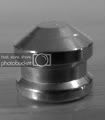
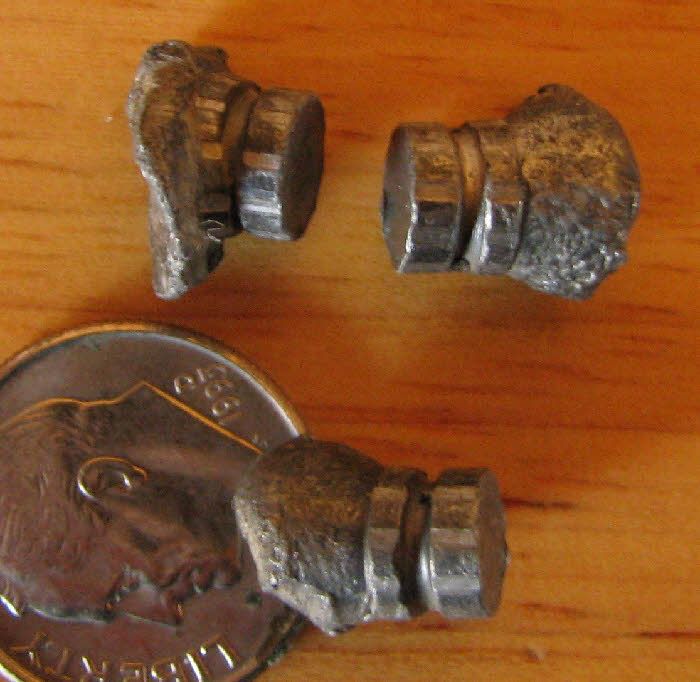
52 grain cast 25 acp bullets in the Condor

I got my mold and some bullets that a member was nice enough to cast for me to try.

When I first talked to him about giving me some bullets to try, he asked if I had slugged my bore, and I had not. So I ran two Kings that I had tapped on to expand them into the bore, one all the way thru to check the choke and one just part way into it to check the bore.

He was taken back by the measurements, the choke was .251 and the bore was .253. He thought that was odd that the LW barrels differed that much and having bought my digital calipers from Harbor Freight I just assume my calipers were off.

I figured when I got the two sample packages of bullets, about 10 each he was sending, I would measure them, then compare those measurements to my calipers.

One thing we did not count on was that the barrel was from the latest batch and may differ from past barrels.

Well when I measured the bullets I recieved today, I found my measurements were correct, and my measurements matched the bullets that he sent. .2495 and .2505. When I chambered the bullets, they slid into the barrel lead easily and went another .25 inch further.

I shot the .2505 bullets and did get one group that was .80, but had to fire 7 shots to get a 5 shot group that was .80. The .2495 bullets just sprayed at 36 yards.

Now I have a unusual shooting bench at my 36 yard range, it is off the top of a 1958 Mercedes in the garage and I use no bags, just my hands to rest on, so sometimes my groups suffer.

I then decided to try the mold and see if I could cast some bullets that would be larger, now I might add I had no way of sizing these bullets when I cast them, other than tweaking alloy or varying the heat, cold alloy usually reduces the bullet diameter.

So I cast some bullets up at 750 to 800 degrees. I started with 40-1 lead to tin because that was what was in my pot. I went thru the ones I could find that were in the .2545 to 255 range,these were too large, but I lubed them with break free and forced them gently into the lead with a flat side of a end wrench.

They shot 1.5 to 3 inches at 36 yards.

So then I reduced the heat to 700 degrees to try and make them a smaller diameter and cast some more, they came out at .253 to .254. THis is usually not a way to cast accurate bullets, but it does make them smaller.

I waited until they cooled, which with these tiny slugs does not take long, then I hand rubbed Johnsons Paste wax on them for lube, this is what I use on my .452 bullets I use in my 45 Ranger and it has stopped the leading problem I was having in that rifle.

The Johnson Paste Wax lubed bullets, that cast out to .253 to.254 could be pushed into the lead flush with considerable thumb pressure, but they were in fact working.

The first group I shot was around 1.5 inches, nothing special, but I did not expect them to group right away, it takes 5 or 6 bullets to get the wax into the barrel.

The next group put 4 shots into one hole and a 5th shot took it to .65. The group after that went into .65 also.

Velocity is 877 to 925, I fill to 3200 PSI, the PW is maxed out and I have a Condor spring, hammer and hammer weight, and a RLAirguns valve stem, Top hat is at .85 this gives me somewhere around 15 shots before I drop into the 860 FPS range.

I need to stress these are not good quality cast bullets that I am shooting right now. The mold is new, and there are a lot of wrinkles. I get 3 or 4 shots into one hole and then a flyer that I know is due to a mold not warmed to the right temperture and being new.

I have a lot of work to do on this and I need to have a sizer die made, it is looking like it needs to be .2525 to .253

Much thanks to the member here who cast me up some slugs and sent them off to me to try and also check my caliper, I owe you big time.

Regards,

Roachcreek

Airforce Rifles/Pistols

All Replies

Viewing 15 replies - 1 through 15 (of 68 total)

1 2 3 4 5

😆

quote roachcreek:

Raptor,

Molds are usually designed to cast at a certain diameter with a certain alloy. The RCBS mold is designed to give that .251 with Lymans #2 alloy I believe. Mine casts 253 to 254 with 30-1 alloy.

Custom molds can be ordered to cast with what ever alloy you specify, my 452 mold from Accuratemolds for the 408 to 420 grain bullets I cast was designed to cast 452 with pure lead, knowing that I could add more tin to make the bullets drop out larger.

Different alloys have different flow characteristics, pure lead will always cast to the smallest diameter, the more tin you add, the more the mold will fill out and give a larger diameter bullet.

The other problem is that mold makers don’t always hit the mark.

This is why we have devices to size bullets.

I personally do not like to size bullets, I would rather cast them at the correct diameter and just pan lube if I have to lube at all. Sometimes this works out, sometimes it does not. The RCBS 251-50 mold is a very tight mold as far as the alignment pins are concerned, as a result it needs to be tapped with the casting stick or rawhide hammer to set the pins each time, and the diameter is dependent on how well it closes.

As a result I have bullets that are slightly out of round and as the mold wears in this dispairity hopefully will correct itself.

You can also reduce you bullet diameter by using products to coat the mold that allow the bullets to drop out easier, such as Frankford arsels mold prep.

Now you add all these variables to the different diameters of barrels from the same manufacturer. Marvins barrel is .2495 mine is .2535.

So the best advice, is first of all measure the bore, push a slug that is oversize to the bore down about halfway with a cleaning rod, then push the slug back out the breech, that will give you the barrel diameter. Now remember you have a choke, you can measure that by pushing the slug completely out the muzzle.

But the middle of the barrel is what you are after for the measurement.

Then you can order a mold.

I personally feel you take a chance when you order a mold from Lyman or RCBS or Lee, they are mass produced. When you order a mold from Accuratemold or LBT, you can specify the alloy you wish to use.

On my 452 I specified pure lead, in my experience some molds are undersize and it is hard to make a undersize mold work, so with pure lead and casting at 452, I knew with allow I could make that bullet bigger and size it down if I needed.

I use a Lyman ladle mold to cast, left over from my days of casting 500 grain bullets, but with a propane camp stove and a cast iron lead pot from lyman, or Lee or RCBS, you will do just fine.

You need a thermometer, it is a must, without it your guessing temperture, and good bullets are tempature dependeant, and each mold is different on the temperture it likes. My 251-50 like to cast at 780 degrees to fill out those tiny bases.

You need a source of lead, Marvin is great a scavenging lead, I used to do that, but in recent years I order my lead, and the best I have seen is Rotometals, if you order $100.00 or more, they ship for free.

The Lee sizer is the best I have seen, simply because it deforms the bullets the least while sizing, it fits in a reloading press and costs under 20.00 for the off the shelf dies, the .25 caliber wil need to be custom ordered and the price is $35.00 delivered.

The RCBS mold is working for us so it may work for you, LBT would be the next best bet. I have owned a few Lee molds, but for the most part they are crap.

To do this on the cheap:

Check on EBAY for used casting equipment, get your used cast iron pot, mold handles and if your lucky your used mold there. Order the correct size sizer die from Lee Prescision custom shop. If you do not have a reloading press, buy a lee portable hand press, it will work fine, it is what I use. Buy your alloy and lead Themometer from Rotometals, start with 30-1 alloy at first. Buy a used propane camp stove if you do not have one.

Before you spend a dime, wait and see how well this works for me after I get my sizer die. I get promising groups for 5 out of 6 shots at 35 yards. I am doing this for larger game like coyotes and up, that will work fine, but remember, you can by a butt load of Kings for what all this costs.

Hope this helps, I am sure I missed a lot here, and Marvin or Tofazou will add to this hopefully.

Regards,

Roachcreek

RC

Thanks for the info. I was able to keep up with most of it, though some of it was over my head. I will definitely wait to see how your experiment turns out before I even think of casting my own. If it works out and I feel casting my own is the way to go, I will probably need your help to duplicate your results if you don’t intend to sell the end product.

Raptor,

Molds are usually designed to cast at a certain diameter with a certain alloy. The RCBS mold is designed to give that .251 with Lymans #2 alloy I believe. Mine casts 253 to 254 with 30-1 alloy.

Custom molds can be ordered to cast with what ever alloy you specify, my 452 mold from Accuratemolds for the 408 to 420 grain bullets I cast was designed to cast 452 with pure lead, knowing that I could add more tin to make the bullets drop out larger.

Different alloys have different flow characteristics, pure lead will always cast to the smallest diameter, the more tin you add, the more the mold will fill out and give a larger diameter bullet.

The other problem is that mold makers don’t always hit the mark.

This is why we have devices to size bullets.

I personally do not like to size bullets, I would rather cast them at the correct diameter and just pan lube if I have to lube at all. Sometimes this works out, sometimes it does not. The RCBS 251-50 mold is a very tight mold as far as the alignment pins are concerned, as a result it needs to be tapped with the casting stick or rawhide hammer to set the pins each time, and the diameter is dependent on how well it closes.

As a result I have bullets that are slightly out of round and as the mold wears in this dispairity hopefully will correct itself.

You can also reduce you bullet diameter by using products to coat the mold that allow the bullets to drop out easier, such as Frankford arsels mold prep.

Now you add all these variables to the different diameters of barrels from the same manufacturer. Marvins barrel is .2495 mine is .2535.

So the best advice, is first of all measure the bore, push a slug that is oversize to the bore down about halfway with a cleaning rod, then push the slug back out the breech, that will give you the barrel diameter. Now remember you have a choke, you can measure that by pushing the slug completely out the muzzle.

But the middle of the barrel is what you are after for the measurement.

Then you can order a mold.

I personally feel you take a chance when you order a mold from Lyman or RCBS or Lee, they are mass produced. When you order a mold from Accuratemold or LBT, you can specify the alloy you wish to use.

On my 452 I specified pure lead, in my experience some molds are undersize and it is hard to make a undersize mold work, so with pure lead and casting at 452, I knew with allow I could make that bullet bigger and size it down if I needed.

I use a Lyman ladle mold to cast, left over from my days of casting 500 grain bullets, but with a propane camp stove and a cast iron lead pot from lyman, or Lee or RCBS, you will do just fine.

You need a thermometer, it is a must, without it your guessing temperture, and good bullets are tempature dependeant, and each mold is different on the temperture it likes. My 251-50 like to cast at 780 degrees to fill out those tiny bases.

You need a source of lead, Marvin is great a scavenging lead, I used to do that, but in recent years I order my lead, and the best I have seen is Rotometals, if you order $100.00 or more, they ship for free.

The Lee sizer is the best I have seen, simply because it deforms the bullets the least while sizing, it fits in a reloading press and costs under 20.00 for the off the shelf dies, the .25 caliber wil need to be custom ordered and the price is $35.00 delivered.

The RCBS mold is working for us so it may work for you, LBT would be the next best bet. I have owned a few Lee molds, but for the most part they are crap.

To do this on the cheap:

Check on EBAY for used casting equipment, get your used cast iron pot, mold handles and if your lucky your used mold there. Order the correct size sizer die from Lee Prescision custom shop. If you do not have a reloading press, buy a lee portable hand press, it will work fine, it is what I use. Buy your alloy and lead Themometer from Rotometals, start with 30-1 alloy at first. Buy a used propane camp stove if you do not have one.

Before you spend a dime, wait and see how well this works for me after I get my sizer die. I get promising groups for 5 out of 6 shots at 35 yards. I am doing this for larger game like coyotes and up, that will work fine, but remember, you can by a butt load of Kings for what all this costs.

Hope this helps, I am sure I missed a lot here, and Marvin or Tofazou will add to this hopefully.

Regards,

Roachcreek

quote roachcreek:

I got my mold and some bullets that a member was nice enough to cast for me to try.

When I first talked to him about giving me some bullets to try, he asked if I had slugged my bore, and I had not. So I ran two Kings that I had tapped on to expand them into the bore, one all the way thru to check the choke and one just part way into it to check the bore.

He was taken back by the measurements, the choke was .251 and the bore was .253. He thought that was odd that the LW barrels differed that much and having bought my digital calipers from Harbor Freight I just assume my calipers were off.

I figured when I got the two sample packages of bullets, about 10 each he was sending, I would measure them, then compare those measurements to my calipers.

One thing we did not count on was that the barrel was from the latest batch and may differ from past barrels.

Well when I measured the bullets I recieved today, I found my measurements were correct, and my measurements matched the bullets that he sent. .2495 and .2505. When I chambered the bullets, they slid into the barrel lead easily and went another .25 inch further.

I shot the .2505 bullets and did get one group that was .80, but had to fire 7 shots to get a 5 shot group that was .80. The .2495 bullets just sprayed at 36 yards.

Now I have a unusual shooting bench at my 36 yard range, it is off the top of a 1958 Mercedes in the garage and I use no bags, just my hands to rest on, so sometimes my groups suffer.

I then decided to try the mold and see if I could cast some bullets that would be larger, now I might add I had no way of sizing these bullets when I cast them, other than tweaking alloy or varying the heat, cold alloy usually reduces the bullet diameter.

So I cast some bullets up at 750 to 800 degrees. I started with 40-1 lead to tin because that was what was in my pot. I went thru the ones I could find that were in the .2545 to 255 range,these were too large, but I lubed them with break free and forced them gently into the lead with a flat side of a end wrench.

They shot 1.5 to 3 inches at 36 yards.

So then I reduced the heat to 700 degrees to try and make them a smaller diameter and cast some more, they came out at .253 to .254. THis is usually not a way to cast accurate bullets, but it does make them smaller.

I waited until they cooled, which with these tiny slugs does not take long, then I hand rubbed Johnsons Paste wax on them for lube, this is what I use on my .452 bullets I use in my 45 Ranger and it has stopped the leading problem I was having in that rifle.

The Johnson Paste Wax lubed bullets, that cast out to .253 to.254 could be pushed into the lead flush with considerable thumb pressure, but they were in fact working.

The first group I shot was around 1.5 inches, nothing special, but I did not expect them to group right away, it takes 5 or 6 bullets to get the wax into the barrel.

The next group put 4 shots into one hole and a 5th shot took it to .65. The group after that went into .65 also.

Velocity is 877 to 925, I fill to 3200 PSI, the PW is maxed out and I have a Condor spring, hammer and hammer weight, and a RLAirguns valve stem, Top hat is at .85 this gives me somewhere around 15 shots before I drop into the 860 FPS range.

I need to stress these are not good quality cast bullets that I am shooting right now. The mold is new, and there are a lot of wrinkles. I get 3 or 4 shots into one hole and then a flyer that I know is due to a mold not warmed to the right temperture and being new.

I have a lot of work to do on this and I need to have a sizer die made, it is looking like it needs to be .2525 to .253

Much thanks to the member here who cast me up some slugs and sent them off to me to try and also check my caliper, I owe you big time.

Regards,

Roachcreek

RC

I am a complete noob when it comes to hand casting pellets. I saw the mold you mentioned (and I think you bought) on midwayusa’s website and it is advertized to produce bullets at a diameter of .251. Do you have the same mold? If you do, then according to your post the actual diameter of the bullets it produces are dependent on several variables like lead to other metal ratios, melt temperatures, as well as, mold temperatures. Can you recommend a research source that I can use to minimize the experience (monetary expense) factor to be able to efficiently hand cast bullet. I know nothing replaces experience, but is there some way to shorten the learning curve?

Marvin,

Thanks, this gives me some idea where to start. I have several LBT molds in 30 and 45 cal. Veral has made adjustments on one. I have no complaints. I still like steel molds though as I have collected so many over the years.

Roachcreek, sorry I didn’t mean to highjack your thread.

JD

Range lead melt . I bhn test my melts after 30 days and prior to casting . I get about a 50-50 mix of 12 and 15 bhn . I keep it separated so I can keep things consistent . With the 30 grain bullets that I did all the testing with at 10 bhn is were accuracy was consistent . But at that time I had to mix my lead to get to 10 . I started at 5 then 6,8,10 12, and 15 bhn . The bullet was cast out of a LBT mold and at first it sprayed the paper . Took me a long time to get the bhn and size down as well as the speed of the bullet to make it accurate . But it is a accurate bullet now . That was my first custom mold and at first quite a let down .But after speeding that much for a mold I was determine to make it work and it does now . At 12 and 15 bhn the bullet maintained accuracy . I settled on 12 bhn so I would not have to mix my lead . I have a small diameter LW barrel size bullets to .2495 could probable get by with .249 but I am tired of buying sizers . I have now acquired about 450 pounds of RF lead that is 10 bhn . Will probable start to use it in short order now that I have it . By the way the 30 grainer does not like to be shoot under 900 fps and prefers over 1000 fps . Marvin

Marvin,

As to the 12 Bhn bullets were you using wheel weights and hardening or another lead/tin alloy? Most of the WW I have cast at about 10Bhn air cooled.

JD

Marvin,

I asume that is Orchard Hardware Store, we have none here, but I will look for that spring at Ace hardware.

After two years, mine is getting a bit tired I think.

Thanks,

Charlie

RC . I did this and I have had no problems . Installed it in May and have shoot the rifle 360 times a week ever since . No miss fires or broken parts too this point in time . Really not a recommended swap on my part and if done by any one I am not responsible for anything you do . The spring does not fit the PW as the stock spring does but I have had no problems with it . If my memory is correct I had to leave the hammer weight out to get the spring to work . It was bought at OHS . It is a servalite spring part number 49U 3 1/2 long , 7/8 OD . , .080 wire. Marvin

Marvin,

You said yuo had a heavier spring, do you have the source for that, price and specs or order # handy.

Regards,

Roachcreek

I just thought you might get bored and want to size a couple bullets . For get the Lee tester old eyes can not work with it . Not sure LBT is still making them . Heard there is a Sacco . I have a Cabine tree .
Remember I said that with this bullet I started out with 12 bhn and have never tried any other hardness because it worked . It was my 30 grain bullet that I did all the bhn testing on . When my retrieved bullets looked like this instead of seared lead on the end is when accuracy was maintained . Marvin

Marvin

For sizing bullets or opening the sizing die once I get it?

I have a metal top on my bench, I could roll them between to sheets of stel to size them, but I am not that desperate yet. 😆

Come payday, I will order some 20-1 and some #2 to harden it from Rotometals.

I have been looking at BHN testers, the Lee is half the money but seems a little complicated compared to the LBT.

Regards,

Roachcreek.

Do you have a drill and sand paper ? Marvin

roachcreek – you have really nailed this whole concept. :8:

Well I went about this testing differently this morning.

And things really improved.

1. I cast from only one cavity of the mold.

2. I tethered at 2600 to obtain maximum velocity.

I am shooting off of the roof of a 1958 Mercedes in the garage, while standing on a wooden box. The gun is suported by a Caldwell range bag, and a rolled up leather jacket I used for casting.

Now about my tether, It keeps me from having to get down off my wooden box, not a soap box by the way, and still the velocity goes up and down as the pressure in the Condor goes up and down, yes it is going thru a regulator, but the pressure has to go down enough in the Condor tank for the valve in the ETAC to be overcome by the pressure from the regulator and opened.

I get a low flyer about every ten shots at 2600 FPS setting and when I do, then I hear the hissing of the regulator refilling the Condors tank. I throw out that shot and shoot 6 shots and measure 5 in the instance.

I am not a bench rest shooter, so today I learned if I twisted the butt plate to the side, it did not tip back and forth, that in itself really improved groups.

My groups at 36 yards for 6- 5 shot groups, throwing out three shots for the auto refilling were .77, .39 .50 .95 .51 and .51 this is a .6 average.

I cast from 40-1 and lubed with a combo of Spray Moly and Breakfree to assist in chambering the slugs. I am sure sizing and a harder alloy is going to help, at least it did for Marvin.

All this in the 100 FPE range. 😀

Regards,

Roachcreek

Viewing 15 replies - 1 through 15 (of 68 total)

1 2 3 4 5
  • You must be logged in to reply to this topic.