


Why bother with .25
I cannot reason with something…why is the .25 caliber more popular as a mod than the .22?
I thought about it for quite a while and heres what i think: If you want more “stopping power” for between the calibers….22 or .25 ???????
I want power, so id like a bigger caliber, but isnt it the same if i use the original .22 barrel and just go for heavier bullets?
The smaller diameter of the bullets makes less wind resistance with the same weight, it also penetrates better into due to size, it tumbles more once it hits and hence makes more damage. Or so i see it….
Isnt this why the AA went from 7.62 to 5.56 caliber?
I still want the .25 caiber one day, but for now it seems to me that the .22 condor with a bulet of the same weight than the .25 bullet will do the same job better – its faster, smaller bullet means less trouble in wind.
Or is the air flow “bigger”? Is the valve on the .25 also different than on the .22?
Id love to hear from you guys cause for me it does not make sence 🙄
All Replies


Thanks to all you guys for the input!
Ill probably go for the .25 since i dont need it for plinking or sutch…..i like power only if it gives results in field.
Thanks again 😀
I bet you already feel more hair growing on your ass! haha
Good choice. I, too, was on the fence for months about going to .25, but when I finally bit the bullet, I was glad I did. I wouldnt go back to .22 for the Condor…….

Thanks to all you guys for the input!
Ill probably go for the .25 since i dont need it for plinking or sutch…..i like power only if it gives results in field.
Thanks again 😀
Ahhhhh…you have seen the light 8)
wow, reading this was an eye opener!
Thanks to all you guys for the input!
Ill probably go for the .25 since i dont need it for plinking or sutch…..i like power only if it gives results in field.
Thanks again 😀

I went from a .20 cal. to a .25cal. and I love it!, but does definately need silencing, simple the heavier the object the more energy it has down range, I’m not going to get any larger cal., well I kinda wouldn’t mind a tuned 909s. I understand if you have sufficient killing power then why ask for more. I think we all are somewhat alittle power mad.

Good points, all. For me, there are no targets involved. I shoot paper targets only to verify zero and to get an idea of how consistently that particular gun shoots so that I will know I can place a bullet exactly where I need it to go on a live animal. It’s all about the hunting, and paper only serves to confirm consistency of shot placement. So if target shooting is your reason for caliber selection, this discussion isn’t relevant for you.
On a live animal, there are 2 ways to kill it and they require very different shot placement. The first is to bleed the animal to death, so your target is the heart/lung area, which is a large target and easy to hit. The second is to put the animal down by incapacitating its nervous system, so your target is the brain or the spine. Either method will kill an animal, but there are vast differences. For a heart/lung shot, the larger the caliber the better, and the faster the bullet the better. Your goal here is to cause as much tissue damage as possible and to create as large a wound channel as possible to bleed the animal out quickly to the point where it collapses. Although this works well and is the standard method for killing an aninal with a high powered weapon, it means that some meat is lost. It also means it takes a certain amount of time to bring the animal down. But, more importantly, it means you will need a specific amount of power to bring the animal down. While it is possible to bring down a large animal with multiple strikes from a .22, it is far from desirable from a hunting standpoint, as you are not likely to have that much time, nor would you wish to make an animal suffer by perforating it with that many tiny holes before bringing it down. So a large caliber weapon with lots of power is the norm here.
The second method does not require large caliber and does not require any more power than is necessary to punch through the skull once to reliably get at the brain inside. Because energy is highly limited in an air powered gun, for any animal of reasonable size (100 lbs or near that), the brain shot becomes the only real shot of choice for an airgun hunter. There are exceptions; a hollowpoint .308 round travelling at near black powder velocities (~1000 fps) could reliably bring down a 100 lb pig or deer with a heart lung shot; but in my case, I never try for the heart lung. And, of course, when considering small game of rabbit size, the caliber isn’t important because the amount of power is overwhelming in relation to the size of the animal.
Bullet weight is therefore critically important and, as the post above shows, the .25 is capable of carrying far heavier bullets. The .22 will only work with bullets of limited weight, as your barrel’s spin rate determines the maximum weight of bullet it will stabilize. So, each barrel is limited as to the heaviest bullet it will stabilize; so you can’t just make an ultra heavy .22 bullet and expect to match a .25 for power by going heavier and heavier. A point will come when your ultra heavy .22 bullet will tumble in flight and be inherently unstable. Keep in mind that velocity has a role in stability. The slower your bullet (given the same barrel with fixed twist rate), the more unstable your bullet becomes. So if you are worried about stability or start to see keyholing in your targets, push them faster and you may be able to stabilize them.
So, for me, the .25 is vastly preferable to the .22. That having been said, I have taken several dozen large pigs, over 150 lbs, using a 22… this was years ago before the ultra heavy .25 slugs became available. In all that time I can only recall 1 instance where the .22 did not have sufficient power to penetrate into the skull. I have since acquired a DAQ 308, and even with 12″ barrel, it has more than enough power to punch through both sides of a large pig’s skull, so I’ve been very happy with it. I have picked up a .25 Talon, though, for testing purposes to see if I can get it quieter and in a smaller package than the DAQ. Testing will commence after I find time to develop the Talon. An important point in going with a .308 over a .25 is that you can drive the 308 slower with the same amount of energy as a .25 with a lighter bullet… for a quieter gun. This may not be important for some of you, but in hawaii it’s THE consideration as no matter where you go here, there are always houses close by.

.22 caliber, the most popular by far, world wide.

Some .25’s are a bit more than “slightly” heavier than any available .22….
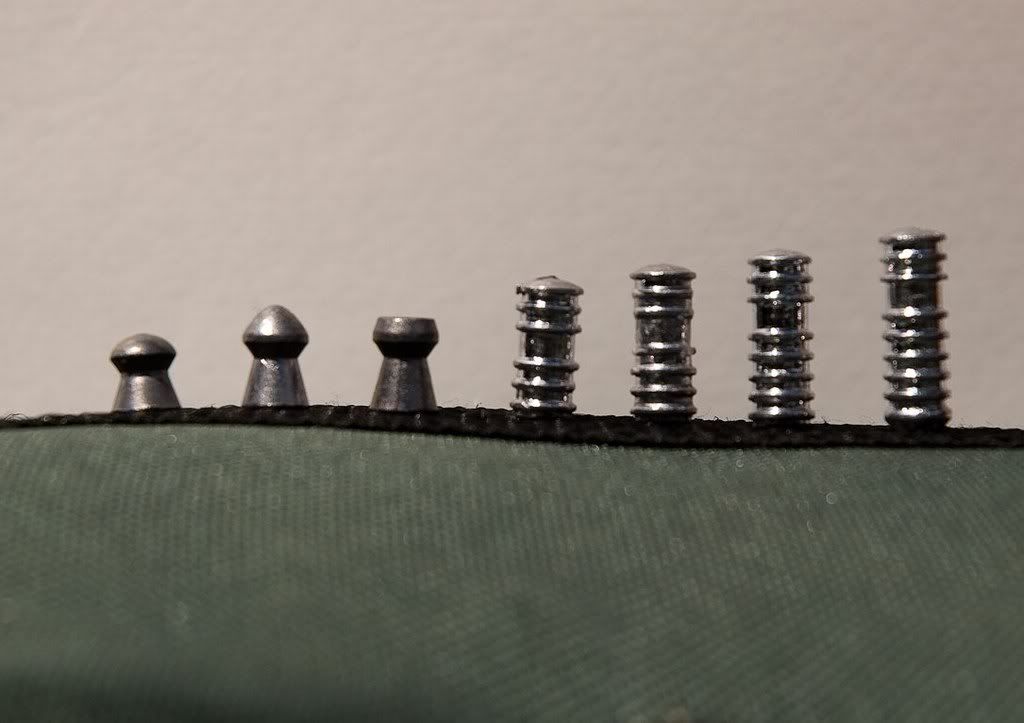

This topic comes up alot. I know you secretely want a .25…..he he he You just need us to push ya in the right direction…he he
It is very true that once you shoot a .25, especially if it has at least the same FPE as the .22 you converted it from or even more, then more than likely you won’t go back to .22…he he. It’s just a preference man, that’s it. Most Europeans have proven time and time again that even the lowly 12 FPE airguns are very successful. Why? Because you only really need about 6 FPE at the TARGET to make a clean kill. So our 40-50-60-70-80-90+ fpe is pretty much a waste of energy cause it is trully overkill. But hey, we are Americans and most of us guys just simply like POWER. Also, just because it is .22 does not mean it is FASTER. Remember, there is only .03″ of a difference between .22 and .25 and between the Eun Jins in .22 which are a tad over 28 grs. and the .25 kodiaks which are slightly over 30 grains you will get the same velocity if not more with the .25. JUST AS I DID. I was shooting .22 Eun Jins at 1075-1080 fps and i simply bought the .25 parts and installed them and shot the first 30.7 grain kodiak and it was doing 1110 fps. In a springer, the bigger the caliber the slower the projectile. But in these highly moddable condor airguns and other fine PCP’s, you can push a .25 projectile just as fast as you can a .22 so the advantage goes to the .25. Even if you don’t really care about SPEED and you only want lets say to push a projectile at 850 fps, the .25 still shines to me over the .22 cause of the slighty heavier projectile and slightly bigger size.
But saying all that, there is still nothing wrong with the .22 using heavy or light projectiles. It is a GREAT CALIBER and one that is hard to beat for accuracy and power. Same holds true for the .20 and .177’s…its all about preference or having the correct tool for the job at hand. That is why i have multiple calibers and multiple guns. All tuned to different FPE but all accurate.

Mind you I don’t have a .25 (I want one though) Every post I can remember reading about people who went from .22 to .25 are happy campers. ATP said it best, the larger surface area means the pressure behind the pellet is used more efficiently. Another way of looking at it is this, given the same displacement and all other things being equal, a six cylinder will give more torque than an eight. Why? Larger surface area for the combustion pressure to act upon.

Yea Ive shot both and will only shoot the .25 anymore.
Shooting Kodiaks from both calibers, the .25 has a flatter trajectory and ultimately hits harder at any range.
I dont care to read about ballistic explanations, that bores me to tears.
All I need to know is my personal experience keeps me shooting the .25s.
Let me put it this way. Ive shot from field mice to porcupine with the .22 and .25 condor. Ive only had to shoot twice with the .25 one time; a crow hopped just when I fired and I only broke its wing.
Sure, Ive missed and made bad shots too. When you make a poor shot, the .25 will help even the odds. Nothing hits harder (unless of course its a larger caliber).
Every time I saddle up the .22 barrel Ive ended up needing a finishing shot or losing squirrels down their holes, most of the time the latter. Ive only lost 2 squirrels out of around 50 with the .25 (I lost count long ago, this was a good year).
Truth be told though, if you’ve never shot a .25 and are happy with your .22… might be a useless discussion. Beware the man/woman with one gun.
Nuff said for me
More energy is imparted on larger surface area of the .25 pellet. It’s possible to get a 42 grain pellet moving almost as fast as the heaviest .22s. Heavier and faster is my only logic. 😉 Heavier generally have a higher coefficient. Ask any guy here and they’ll show you the .25 has tested ballistically superior.
- You must be logged in to reply to this topic.
Gents; Sadly, I too am a .25 cal convert. I grew up with a Savage .22 LR with a thing my grandfather called a scope. I wore the rifle out.
I’ve used .177 springers through the years with good results but I jumped back into air rifles when the need arose. The Condor caught my eye and I’ve been hooked ever since.
Now for the piece about the .25 cal. I’ve a .22 cal Condor with an Air Hog lead collector and a modified TalonSS in .22 cal. Both have served me extremely well.
I bought a Tim Wilson modified Talon in .25 cal and added a Tony shroud. That’s the only rifle I pick up these days. Why? Stopping POWER! If I need more I could always go back to the gun safe and pull out a 4,000+ FPE monster and blow windows out in the neighborhood when I pull the trigger from the blast. My neighbors would not understand.
The .25 hybrid is not only powerful but is as silent as the wife drugged out on Ambien.
AKULA